> From: https://gemini.google.com/app/874916684c7e3ccf
# you asked
message time: 2026-10-26 16:58:16
Review this article and our work on nanodiamonds from low-watt laser:
"On the Conduction Mechanism in Diamond 2-D Hole Gas Field Effect Transistors" | IEEE Journals & Magazine | IEEE Xplore https://ieeexplore.ieee.org/document/11569502
---
# gemini response
### Overview of the Paper
**"On the Conduction Mechanism in Diamond 2-D Hole Gas Field Effect Transistors"** (A. J. Walker, M. S. Hanna, B. Henderson, L. Galambos; *IEEE Access*, 2026) investigates how carriers move and leak in hydrogen-terminated diamond 2DHG FETs by borrowing core MOS analytical frameworks from silicon:
1. **Silicon-Style Characterization:**
* Instead of relying primarily on standard Hall effect measurements (which average bulk/surface effects and miss localized trap kinetics), the authors apply **quasi-static capacitance–voltage ($C$–$V$) analysis**, **effective vertical field ($E_{\text{eff}}$) formulation**, and **Arrhenius barrier extraction**.
2. **Temperature-Activated Transport:**
* Conduction across the full $V_{GS}$ sweep is thermally activated. This behavior resembles disordered or non-crystalline channel devices rather than ideal single-crystal inversion layers, highlighting that surface disorder, atmospheric adsorbates, and interface traps dominate over pure phonon scattering.
3. **Trap States and Mobility Degradation:**
* The effective vertical electric field pulls holes tight against the interface. A large fraction of injected carriers become trapped in interfacial states, drastically reducing effective mobile carrier mobility.
4. **Leakage Mechanisms (GIDL Analogs):**
* The study reports a gate-induced drain leakage (GIDL)-like mechanism, surprising in intrinsically undoped diamond substrates, caused by high localized band bending and trap-assisted tunneling near drain-gate overlap zones.
---
### Connecting to Nanodiamonds Synthesized via Low-Watt Laser
Synthesizing nanodiamonds (NDs) using low-wattage lasers (e.g., pulsed or continuous-wave liquid-phase laser ablation/transformation) produces particles with distinct surface and structural characteristics. Looking at that synthesis method through the lens of this IEEE paper reveals key intersections:
```
Low-Watt Laser Nanodiamonds Walker et al. (IEEE 2026)
• High surface-to-volume ratio • Surface transfer doping / 2DHG
• Complex surface termination (C-H, C-O, sp²) • Interface trap states & mobility degradation
• Defect / grain boundaries • Thermally activated hopping conduction
```
#### 1. Surface Chemistry & Transfer Doping
* **Paper's context:** Diamond 2DHG formation relies strictly on hydrogen termination coupled with surface transfer doping (electron transfer from the diamond valence band to surface adsorbates/dielectrics).
* **Low-watt laser context:** Low-watt laser synthesis in liquid media (water, ethanol, organic precursors) typically leaves a heterogeneous surface containing mixed $sp^2/sp^3$ carbon, carbonyls, hydroxyls, and hydrogen bonds. To leverage or evaluate 2DHG effects in films assembled from these NDs, precise post-processing (e.g., hydrogen plasma annealing) is required to remove graphitic $sp^2$ shells and enforce pure C–H termination.
#### 2. Interface Traps vs. Nanocrystalline Grain Boundaries
* **Paper's context:** Walker et al. demonstrate that carrier mobility in 2DHG FETs is bottlenecked by interface state trapping rather than bulk lattice scattering, showing temperature-activated conduction characteristic of disordered interfaces.
* **Low-watt laser context:** If your low-watt laser process is used to grow seeded diamond layers or assemble thin-film channels, the grain boundaries and defect density inherent to laser-synthesized NDs will dramatically increase the density of localized trap states ($D_{it}$). Conduction across such films will likely follow variable-range hopping (VRH) or nearest-neighbor hopping rather than 2D band transport.
#### 3. Electric Field Concentration and Leakage
* **Paper's context:** The unexpected GIDL-like leakage observed in single-crystal/bulk slices stems from high local field-assisted carrier emission at interface traps.
* **Low-watt laser context:** In nanodiamond-based composite films or seeded layers, local field enhancement around sharp nanoparticle geometries and boundary graphitic clusters will exacerbate trap-assisted tunneling, making field-dependent dielectric leakage a major hurdle for high-voltage switching.
---
### Potential Research Directions & Synergies
| Focus Area | Challenge Identified in Paper | Opportunity for Low-Watt Laser Nanodiamonds |
| :--- | :--- | :--- |
| **Surface Passivation** | Adsorbate-based 2DHG is unstable over time and sensitive to thermal cycling. | Laser-assisted surface photochemical functionalization to graft stable acceptor groups onto diamond surfaces without requiring air adsorbates. |
| **Seeding & Thin Films** | High substrate cost ($2+$ carat single crystals) limits widespread commercial adoption. | Using laser-derived NDs as ultra-clean nucleation seeds for wafer-scale heteroepitaxial diamond growth on silicon/sapphire. |
| **Defect Spectroscopy** | $C$–$V$ and Arrhenius methods revealed dense mid-gap states. | Applying the paper's low-noise quasi-static $C$–$V$ extraction techniques to directly quantify the electronic trap density of laser-treated ND films. |
---
# you asked
message time: 2026-10-26 16:59:46
How do low-watt laser synthesis parameters like liquid medium, pulse duration, and wavelength impact diamond surface termination and electrical properties?
---
# gemini response
In low-watt laser synthesis in liquids—such as laser ablation in liquids (LAL) or the laser-driven conversion of diamondoid precursors (adamantane, aza-adamantane, carbon targets)—nanodiamond (ND) nucleation occurs inside a confined, high-pressure, high-temperature plasma plume. The parameters governing the laser and its surrounding medium directly dictate the resulting surface chemistry, $sp^2/sp^3$ ratio, and downstream electrical conduction mechanisms.

[Laser ablation in solution setup](https://en.wikipedia.org/wiki/Laser_ablation_synthesis_in_solution)
---
### 1. Liquid Medium: Chemical Termination & Surface Doping
The liquid surrounding the focal zone provides the confining inertia that raises plasma shock pressures into the diamond stability window ($P > 10\text{ GPa}$, $T > 3000\text{ K}$), while its molecular dissociation products chemically terminate the hot particle surfaces.
* **Deionized Water ($H_2O$):**
* *Surface Chemistry:* Thermal and plasma dissociation yields abundant $\cdot OH$, $\cdot H$, and $O^{2-}$ radicals. The resulting ND surfaces are dominated by hydroxyl ($-OH$), carboxyl ($-COOH$), and cyclic ether/lactone groups.
* *Electrical Impact:* Oxygen termination produces a positive electron affinity ($\chi > 0$), deep hole traps, and high surface resistivity. It suppresses surface transfer doping, eliminating any intrinsic 2-D hole gas (2DHG) channel and yielding purely insulating particles ($R > 10^{12}\ \Omega$).
* **Alcohols and Hydrocarbons (Ethanol, Toluene, Hexane, Adamantane solutions):**
* *Surface Chemistry:* Solvent dissociation generates rich active carbon and hydrogen species with minimal oxygen. This preferentially stabilizes **$C\text{–}H$ termination** while depositing an ultrathin graphitic/amorphous carbon ($sp^2$) shell around the $sp^3$ core during the cavitation quench.
* *Electrical Impact:* Pure C–H termination lowers the diamond work function and induces negative electron affinity (NEA, $\chi \approx -1.3\text{ eV}$). When exposed to ambient air or molecular acceptors, this enables **surface transfer doping** and 2DHG formation. However, incomplete graphitic shell removal leads to unwanted parallel $sp^2$ leakage pathways.
* **Nitrogen-Containing Solvents (Acetonitrile, Liquid $N_2$, or dissolved Aza-adamantane):**
* *Surface Chemistry:* In-situ incorporation of nitrogen defects ($N_V^0, N_V^-$, and substitutional $P1$ centers) along with surface amino ($-NH_2$) and nitrile ($-C\equiv N$) terminations.
* *Electrical Impact:* Substitutional nitrogen acts as a deep donor ($E_d \approx 1.7\text{ eV}$ below the conduction band), pinning the Fermi level near mid-gap and increasing bulk trap-assisted tunneling barriers.
---
### 2. Pulse Duration: Thermal Partitioning vs. Defect Density
Pulse duration controls the balance between non-thermal photochemical bond-breaking and localized thermal heating.
| Regime | Synthesis Physics | Surface & Interface Structure | Electrical Conduction Impact |
| :--- | :--- | :--- | :--- |
| **Femtosecond / Picosecond**
*(fs – ps)* | **Non-thermal phase explosion.** Peak intensities exceed $10^{13}\text{ W/cm}^2$ even at low average wattages. Fast optical breakdown outpaces thermal diffusion. | **Minimal $sp^2$ reconstruction.** Extremely fast quenching rates ($>10^{11}\text{ K/s}$) freeze the high-pressure diamond phase with sharp interfaces and thin graphitic boundaries. | **Steep Subthreshold Slopes & Low GIDL.** Interface trap density ($D_{it}$) at grain boundaries is minimized. Minimizes the trap-assisted tunneling and gate-induced drain leakage (GIDL) described by Walker et al. |
| **Nanosecond**
*(ns)* | **Plasma heating & shock confinement.** The laser pulse continues to heat the expanding plasma plume; cavitation bubbles linger longer ($10\text{–}100\ \mu\text{s}$). | **Thick $sp^2$ fullerene/graphitic shells.** Slower cooling permits surface graphitization of the metastable $sp^3$ core via surface reconstruction. | **Hopping Conduction.** Conduction across films of these NDs is dominated by variable-range hopping (VRH) through localized graphitic states rather than 2D band transport. |
---
### 3. Laser Wavelength: Optical Penetration & In-Flight Annealing
The choice of laser wavelength governs absorption efficiency in the precursor target, the solvent's transmission window, and secondary photo-induced remodeling of suspended nanoparticles.
* **Ultraviolet (DUV / UV: 213 nm – 355 nm):**
* *Interaction Mechanism:* Photon energies ($3.5\text{–}5.8\text{ eV}$) directly match the electronic bandgaps of hydrocarbons and diamondoid precursors, driving direct single-photon photochemical cleavage over purely thermal ablation.
* *Electrical & Structural Impact:* Minimizes graphitization and selectively photo-etches surrounding $sp^2$ carbon shells ($C=C$ $\pi\text{–}\pi^*$ transitions absorb strongly in the UV). This yields high-purity $sp^3$ grains with low structural defect densities and lower trap states near the band edges.
* **Near-Infrared (NIR: 1064 nm):**
* *Interaction Mechanism:* Absorption relies heavily on multi-photon ionization or pre-existing seed absorption (free-carrier and inverse Bremsstrahlung absorption).
* *Electrical & Structural Impact:* Secondary interaction between the trailing beam and previously synthesized nanoparticles heats the dispersed colloids, often causing thermal annealing that increases grain size but thickens the surrounding $sp^2$ graphitic boundary. This enhances film conductivity while lowering overall carrier mobility.
---
### Synthesis-to-Device Design Map
To optimize low-watt laser-synthesized diamond for stable electronic devices and avoid the severe trapping mechanisms highlighted in recent 2DHG studies:
1. **For 2DHG FET Channels:** Use **short pulses (fs/ps)** in a **hydrocarbon/alcohol medium** to maximize $C\text{–}H$ termination and prevent thermal graphitization, followed by selective UV oxidation or gentle etching to strip boundary $sp^2$ states.
2. **For High-Voltage Dielectric Buffers / Insulators:** Use a **water-based medium** under **UV exposure** to generate complete, high-barrier oxygen termination ($-O-$, $-OH$), suppressing leakage and eliminating transfer-doped conductive channels.
---
# you asked
message time: 2026-10-26 17:00:16
What are the best chemical and thermal post-synthesis methods to remove sp2 graphitic shells from laser-synthesized nanodiamonds without damaging C-H surface termination?
---
# gemini response
Selective removal of external $sp^2$ graphitic/amorphous carbon shells from nanodiamonds (NDs) while **preserving or cleanly re-establishing pure $C\text{–}H$ termination** presents a strict thermodynamic challenge: $sp^2$ stripping agents (like strong oxidizers or air) preferentially oxygenate the diamond surface into $-OH$, $-COOH$, or $C=O$ species.
To retain or restore pristine $C\text{–}H$ termination, the process requires either a **direct selective dry-gas reduction/etch** or a **controlled oxidation followed by immediate dry hydrogenation**.
---
### 1. Direct Hydrogen Plasma Etching (Single-Step Benchmark)
Microwave-plasma or inductively coupled remote-plasma chemical vapor deposition (MPCVD / ICP-CVD) systems operating in pure $H_2$ are the standard for single-step $sp^2$ removal and concurrent $C\text{–}H$ saturation.
```
[Graphitic sp² Shell + Diamond sp³ Core]
│
▼ H* Radicals (Atomic Hydrogen)
┌───────────────────────────────────┐
│ 1. sp² Etch: C(sp²) + 4H* ──► CH₄ │ (Etch rate: sp² >> sp³)
│ 2. sp³ Passivation: C(sp³) ──► C-H│ (NEA, 2DHG preserved)
└───────────────────────────────────┘
│
▼
[Pristine C-H Terminated Nanodiamond Core]
```
* **Mechanism:** High-density atomic hydrogen radicals ($H^*$) selectively gasify $sp^2$ carbon to methane ($CH_4$) at rates **2 to 3 orders of magnitude faster** than diamond $sp^3$ etching:
$$C(sp^2) + 4H^* \longrightarrow CH_4\ (\text{gas})$$
Simultaneously, active hydrogen atoms saturate open dangling bonds on the exposed diamond facet, stabilizing the (111) and (100) surfaces into monohydride and dihydride terminations.
* **Process Parameters:**
* **Substrate Temperature:** $600^\circ\text{C} - 750^\circ\text{C}$ (temperatures above $800^\circ\text{C}$ risk spontaneous diamond surface graphitization in vacuum; below $500^\circ\text{C}$, the $sp^2$ etch rate is too slow).
* **Chamber Pressure:** $20 - 40\text{ Torr}$ pure $H_2$ (forming gas $95\%\ N_2 / 5\%\ H_2$ is avoided to prevent nitrogen insertion or amine termination).
* **Microwave/RF Power:** Moderate power ($500 - 800\text{ W}$) or remote downstream configuration to prevent ion bombardment damage and sputtering of the nanodiamond cores.
---
### 2. Low-Temperature Catalytic Hydrogasification (Thermal Tube Furnace)
When microwave plasma is unavailable, atmospheric or low-pressure thermal annealing in pure hydrogen cannot sufficiently crack molecular $H_2$ below $800^\circ\text{C}$. Introducing trace transition metal nanoparticle catalysts enables low-temperature selective stripping.
* **Mechanism:** Nanoparticles of transition metals (e.g., Ni, Co, Fe, or Ru) or transition-metal-doped substrates act as catalytic dissociation sites for $H_2 \rightarrow 2H^*$. These activated species migrate via hydrogen spillover to dissolve and gasify disordered $sp^2$ carbon into volatile hydrocarbons at temperatures far below bulk diamond degradation thresholds.
* **Process Parameters:**
* **Atmosphere:** High-purity $H_2$ ($99.999\%$) or forming gas ($95\%\ Ar / 5\%\ H_2$).
* **Temperature:** $450^\circ\text{C} - 550^\circ\text{C}$.
* **Cycle:** 1–2 hours. The sacrificial trace metal catalyst is subsequently removed via mild, non-oxidizing dilute $HCl$ acid washing (which leaves $C\text{–}H$ bonds intact, unlike nitric or sulfuric acid).
---
### 3. Two-Step Decoupled Route: Selective Air/Ozone Etch $\rightarrow$ Pure $H_2$ Thermal Passivation
Liquid-phase acid baths (e.g., boiling perchloric/nitric/sulfuric tri-acid mixtures) aggressively strip graphitic shells, but they replace them with complex polyfunctional oxygen layers (hydroxyl, carboxyl, anhydride) that resist complete reduction. A cleaner approach decouples $sp^2$ removal from hydrogen termination using dry-phase processing:
| Step | Technique | Target Reaction | Surface State |
| :--- | :--- | :--- | :--- |
| **Step 1: Selective Strip** | **Controlled Air / Ozone Oxidation**
*(Static air at $420^\circ\text{C} - 450^\circ\text{C}$ OR UV/ozone at $150^\circ\text{C}$)* | Graphitic carbon oxidizes to $CO/CO_2$ at $\sim 420^\circ\text{C}$, whereas single-crystal diamond resists thermal oxidation in air up to $\sim 550^\circ\text{C} - 600^\circ\text{C}$. | Fully oxygen-terminated diamond core ($-O-$, $-C=O$, $-OH$). No residual $sp^2$ boundary. |
| **Step 2: Dry Reduction** | **High-Temperature Molecular $H_2$ Anneal**
*(Tube furnace at $700^\circ\text{C} - 800^\circ\text{C}$ under flowing $H_2$)* | Desorbs surface oxygen species ($H_2O$ and $CO$ elimination) and saturates open surface sites with atomic/molecular hydrogen without introducing plasma damage. | Pure $C\text{–}H$ termination, negative electron affinity, restored 2DHG transfer-doping capability. |
---
### Process Verification & Quality Metrics
To verify that the $sp^2$ shell is eliminated without compromising the $C\text{–}H$ surface:
1. **Raman Spectroscopy ($532\text{ nm}$ and UV $244\text{ nm}$):**
* *Target:* Disappearance of the broad $D$-band ($\sim 1350\text{ cm}^{-1}$) and $G$-band ($\sim 1580\text{ cm}^{-1}$), leaving only the sharp $sp^3$ diamond phonon line at $1332\text{ cm}^{-1}$. (UV Raman is especially sensitive to the $sp^3$ phase).
2. **FTIR / ATR Spectroscopy:**
* *Target:* Vanishing of the $C=O$ carbonyl stretch ($1720 - 1780\text{ cm}^{-1}$) and $C-O-C$ ether bands ($1100 - 1300\text{ cm}^{-1}$); strong emergence of symmetric and asymmetric $C\text{–}H_x$ stretches in the $2820 - 2960\text{ cm}^{-1}$ window.
3. **X-ray Photoelectron Spectroscopy (XPS):**
* *Target:* Narrowing of the $C 1s$ peak toward $\sim 284.0\text{ eV}$ with negligible oxygen contribution ($O 1s < 1\text{ at}\%$).
---
# you asked
message time: 2026-10-26 17:00:50
Can these be made from lignin? Plastic?
---
# gemini response
Nanodiamonds can be synthesized directly from both **lignin** and **plastics (polymers)** using low-watt laser conversion. In fact, polymers and aromatic bio-macromolecules serve as high-yield solid carbon precursors because they supply both the dense carbon backbone and localized hydrogen/confinement needed during the laser-induced shock transformation.
---
### 1. Synthesizing Nanodiamonds from Lignin
Lignin is an aromatic, highly cross-linked polyphenolic network (guaiacyl, syringyl, and $p$-hydroxyphenyl units).
* **Mechanism & Precursor Chemistry:**
* When subjected to focused laser pulses (pulsed NIR or UV), lignin undergoes rapid localized photothermal pyrolysis and photo-fragmentation.
* Unlike pristine graphite, lignin carries a high concentration of native hydrogen (aliphatic and phenolic C–H) and ether linkages (C–O–C). Under laser-induced shock compression in a liquid or confined boundary, the high local carbon density and thermal decomposition create a carbon-supersaturated plasma that nucleates $sp^3$ diamond cores ($2\text{–}10\text{ nm}$).
* **Precursor Optimization:**
* **Ash/Mineral Contaminants:** Commercial Kraft lignin contains trace sulfur ($1\text{–}3\%$) and inorganic salts (sodium, silica, ash), which act as parasitic absorption centers or introduce metallic/sulfur trap states into the diamond lattice. Utilizing de-ashed **Organosolv lignin** ($<0.1\%$ ash) is essential for producing electronic-grade nanodiamonds.
* **Processing Geometry:** Liquid suspension (lignin nanoparticles dispersed in ethanol or water) or spin-coated thin films sandwiched under a confining transparent overlay (e.g., quartz or sapphire) to maximize the peak shock pressure above the $10\text{ GPa}$ diamond stability line.
---
### 2. Synthesizing Nanodiamonds from Plastics
Plastics are effective precursors for laser synthesis, with conversion dynamics dictated primarily by the polymer's chemical backbone.
```
Laser Pulse (fs, ps, ns)
│
▼
┌────────────────────────────────────────────────────────┐
│ Hydrocarbon Plastics (PET, PS, PE, PI) + Confinement │
└────────────────────────────────────────────────────────┘
│
▼ High P (>10 GPa), High T (>3500 K)
┌────────────────────────────────────────────────────────┐
│ 1. Photochemical Backbone Cleavage │
│ 2. Carbon/Hydrogen Plasma Cavitation Quench │
│ 3. sp³ Nucleation & Rapid Freezing (<10¹¹ K/s) │
└────────────────────────────────────────────────────────┘
│
▼
[ sp³ Core with Native C-H Passivation ]
```
* **Polyethylene Terephthalate (PET):**
* PET ($\text{C}_{10}\text{H}_8\text{O}_4$) has an ideal stoichiometry of carbon, hydrogen, and oxygen. Laser shock compression experiments (including planetary-analogy studies) demonstrate that oxygen accelerates phase separation between carbon and hydrogen, promoting spontaneous diamond precipitation while oxygen binds excess hydrogen as $\text{H}_2\text{O}$.
* **Polystyrene (PS) & Polyimide (PI):**
* Aromatic rings provide high carbon yield ($sp^2$-dense structures that collapse efficiently into $sp^3$ networks under shock). Polyimide's strong optical absorption across UV and mid-IR facilitates low-threshold breakdown even at low laser wattages.
* **Aliphatic Polyolefins (PE, PP):**
* Saturated polymers ($\text{–CH}_2\text{–CH}_2\text{–}$) deliver a high $\text{H/C}$ ratio ($2:1$). Laser ablation of polyethylene in liquid or confined geometries produces high-purity $C\text{–}H$ passivated NDs, as the excess hydrogen directly caps dangling surface bonds during the quenching plume, preventing extensive graphitic shell formation.
---
### Comparative Evaluation: Lignin vs. Plastics vs. Traditional Graphite
| Metric / Parameter | Lignin Precursors | Synthetic Plastics (PET, PS, PE) | Traditional Solid Carbon (Graphite / Glassy Carbon) |
| :--- | :--- | :--- | :--- |
| **Laser Absorption Threshold** | Moderate to High (natural chromophores, phenolic absorption in UV/VIS) | Polymer-dependent (high in PI/PET; low in pure PE without UV/dopants) | Low (very high optical absorption across all wavelengths) |
| **In-Situ Hydrogen Availability** | Moderate (phenolic/aliphatic $H$ present) | **Very High** (built-in $C\text{–}H_x$ groups promote direct hydrogen passivation) | Negligible (requires external liquid medium like ethanol or $\text{H}_2\text{O}$) |
| **Purity & Defect Profile** | Contains native $O$, trace $N$, and potential ash/S; yields functionalized NDs | Predictable; pure hydrocarbon or oxy-hydrocarbon lattices | High elemental purity, but high graphitic boundary fraction |
| **Post-Synthesis Cleaning** | Requires mild catalytic stripping or clean $\text{H}_2$ anneal to remove bio-char | Easier removal of aliphatic residues via low-temperature thermal desorptions | Heavy $sp^2$ graphitic/fullerene shell needs intense plasma etching |
---
### Relevance to Electronic Devices (2DHG FETs)
Connecting back to the conduction and trapping mechanisms from Walker et al.:
1. **Direct $C\text{–}H$ Retention:** Using hydrogen-rich polymers (PE, PS) or high-hydrogen lignin fractions under laser ablation reduces the thickness of the outer graphitic shell. This allows the particles to maintain higher native hydrogen termination without requiring destructive acid boiling.
2. **Impurity Trapping:** Lignin-derived NDs must be thoroughly purified to avoid deep sulfur and transition-metal traps that would otherwise degrade carrier mobility and increase gate-induced leakage in 2DHG devices. Polyolefin- or PET-derived nanodiamonds offer an electrically cleaner, highly reproducible baseline for semiconductor seeding and thin-film transistor channels.
---
# you asked
message time: 2026-10-26 17:01:45
Yes, both
---
# gemini response
An engineered low-watt laser conversion setup translates de-ashed Organosolv lignin and PET/aliphatic plastics into high-purity nanodiamonds (NDs) through laser shock compression, photochemical bond breaking, and tailored confinement geometries.
---
### Part 1: Laser Parameters & Confinement Geometry for PET & Lignin
Converting polymers or bio-macromolecules into nanodiamonds via low average-power lasers requires decoupling **peak pulse intensity** (for shock-wave generation and non-thermal bond breaking) from **average thermal load** (to prevent graphitization of the metastable $sp^3$ phase).
```
Focused Laser Beam
(fs / ps Pulsed NIR or UV)
│
▼
┌────────────────────────────────────────────────────────────┐
│ Transparent Confinement Overlay (Quartz, Fused Silica) │
├────────────────────────────────────────────────────────────┤ Shock Wave
│ Sacrificial Ablation / Plasma Layer (Water or Cryo-Alcohol)│ P > 10–25 GPa
├────────────────────────────────────────────────────────────┤ T > 3000–4500 K
│ Precursor Layer: PET Film / De-ashed Organosolv Lignin │
├────────────────────────────────────────────────────────────┤
│ Substrate (Silicon, Sapphire, or Heat-Sink Cu) │
└────────────────────────────────────────────────────────────┘
```
#### 1. Confinement Geometries
Direct surface ablation in ambient air merely yields laser-induced graphene (LIG) or bio-char because the plasma plume expands freely, capping transient pressure below $0.1\text{ GPa}$. To achieve the $>10\text{–}25\text{ GPa}$ required for the diamond phase boundary:
* **Planar Confined-Shock Geometry (Thin Film Target):**
* Spin-coat a dense film ($1\text{–}5\ \mu\text{m}$) of purified Organosolv lignin (solvated in DMF/ethanol) or a biaxially oriented PET film onto a rigid substrate (e.g., Sapphire or Si).
* Cover with an optically transparent inertial tamper layer (**fused silica or quartz slide**, $1\text{–}2\text{ mm}$ thick) with an ultrathin liquid boundary (water or ethanol film, $10\text{–}50\ \mu\text{m}$) sandwiched in between.
* The transparent tamping layer prevents rapid volume expansion, forcing the plasma recoil pressure to exceed $20\text{ GPa}$ for hundreds of picoseconds.
* **Liquid-Suspension Micro-Cavitation (Colloidal Target):**
* Sub-micron particles of Organosolv lignin or PET nanosuspensions are dispersed in a liquid cell (deionized water or ethanol) equipped with a magnetic stirrer or microfluidic flow channel.
* A high-numerical-aperture objective focuses the beam into the liquid. Optical breakdown creates a cavitation bubble whose inertial collapse adds secondary acoustic shock pressure to the nanosecond/picosecond optical plasma.
#### 2. Wavelength, Pulse Duration, and Fluence Windows
| Parameter | Recommended Window | Mechanism & Role |
| :--- | :--- | :--- |
| **Laser Pulse Duration** | **Femtosecond (fs):** $100 - 350\text{ fs}$
*Alternative:* Picosecond ($10 - 50\text{ ps}$) | fs pulses deliver peak power densities $>10^{13}\text{ W/cm}^2$ even at low average wattages ($1 - 5\text{ W}$), bypassing linear thermal diffusion. It induces a pure non-thermal Coulomb explosion and ultrafast phase transition before thermal graphitization can occur. |
| **Wavelength** | **DUV/UV (266 nm or 355 nm)**
*(or NIR 1030–1064 nm fs)* | UV photons ($3.5\text{–}4.66\text{ eV}$) directly match the aromatic absorption bands of lignin (phenolic chromophores) and PET ($\pi\text{–}\pi^*$ transitions), facilitating single-photon photochemical cleavage of C–C and C–O bonds. |
| **Fluence** | **$1.5 - 4.5\text{ J/cm}^2$** (focused) | Operates strictly above the optical ablation/shock threshold ($\sim 1.0\text{ J/cm}^2$), but well below the excessive thermal heating regime ($>8\text{ J/cm}^2$) that vaporizes carbon or stabilizes graphite. |
| **Repetition Rate** | **$1\text{ kHz} - 100\text{ kHz}$** | Low duty cycle minimizes cumulative substrate heating. High scan speeds ($100 - 500\text{ mm/s}$) prevent multi-pulse thermal accumulation on previously formed nanodiamond seeds. |
---
### Part 2: Laser-Induced Shock-Compression & Yield in PET
PET ($\text{C}_{10}\text{H}_8\text{O}_4$) is an efficient solid-state precursor for laser-driven diamond precipitation due to its specific elemental stoichiometry and phase-separation dynamics under extreme conditions.
```
[ PET Backbone: -O-CH₂-CH₂-O-CO-C₆H₄-CO- ]
│
▼ Laser Shock (P > 15 GPa, T ~ 4000 K)
┌─────────────────────────────────────────────────────────┐
│ Rapid Photo-Chemical Homolysis (C-C, C-O, C-H Bonds) │
└─────────────────────────────────────────────────────────┘
│
▼ Fast Demixing / Phase Separation
┌───────────────────────────────┬─────────────────────────┐
│ Dense Supercritical C-Fluid │ Water / Volatile Fluid │
│ Carbon supersaturation │ Oxygen captures H │
│ Rapid sp³ crystallization │ Forms high-P H₂O / CO │
└───────────────────────────────┴─────────────────────────┘
│
▼ Quenching (<10¹¹ K/s)
[ Nanodiamond Crystallites (2–5 nm) ]
```
1. **Endogenous Oxygen-Driven Phase Demixing:**
* In pure hydrocarbon polymers (e.g., polystyrene), carbon-hydrogen separation under shock requires pressures exceeding $25\text{–}30\text{ GPa}$.
* In PET, the built-in oxygen atoms chemically bind with hydrogen, forming superionic/supercritical $\text{H}_2\text{O}$ (and volatile $\text{CO}/\text{CO}_2$). This drives spontaneous phase separation between water and carbon at lower pressures ($15\text{–}20\text{ GPa}$), precipitating pristine carbon clusters that freeze into $sp^3$ diamond crystallites ($2\text{–}5\text{ nm}$).
2. **Yield Expectations & Collection:**
* **Mass Conversion Efficiency:** In planar confined-shock geometries, local carbon-to-diamond mass conversion within the focal interaction volume reaches **$15\text{–}35\%$**. Unconverted material forms an outer graphitic skin and aliphatic fragments.
* **Purity:** Because pure commercial optical-grade PET has undetectable mineral ash and virtually zero sulfur or transition metals, the core $sp^3$ lattice is free of deep-level metallic traps, making it suitable for clean semiconductor seeding.
---
### Part 3: Organosolv vs. Kraft Lignin for Carbon Nanomaterials
The structural and chemical composition of technical lignins directly dictates the purity, defect profile, and processing efficiency of the resulting diamond nanoparticles.
| Feature / Metric | Organosolv Lignin | Kraft Lignin | Technical Impact on Nanomaterial Synthesis |
| :--- | :--- | :--- | :--- |
| **Ash / Mineral Content** | **Ultra-low ($< 0.1\text{ wt}\%$)** | **High ($1.5 - 5.0\text{ wt}\%$)** | Kraft contains inorganic $\text{Na}_2\text{SO}_4$, $\text{Na}_2\text{CO}_3$, and $\text{SiO}_2$. These minerals vaporize under the laser beam, creating optical micro-arcing and introducing ionic charge traps into the diamond film. |
| **Sulfur Content** | **$0.0\text{ wt}\%$ (Sulfur-free)** | **$1.5 - 3.5\text{ wt}\%$** | Sulfur integrates into the carbon lattice as a localized deep-level trap, causing severe trap-assisted tunneling and degrading subthreshold swing in 2DHG FETs. |
| **Solubility & Purity** | Readily soluble in green organic solvents (ethanol, acetone, DMF) | Poorly soluble in organics; requires alkaline water ($\text{pH} > 11$) | Organosolv forms uniform, optically flat spin-coated films with homogeneous optical absorption, preventing localized pinholes and irregular laser ablation. |
| **Molecular Structure & $M_w$** | Low molecular weight ($M_w \approx 1000 - 3000\text{ g/mol}$), narrow polydispersity, high retention of $\beta\text{-O-}4$ ether linkages | High molecular weight ($M_w \approx 3000 - 10000\text{ g/mol}$), heavily cross-linked, high C–C condensed bonds | Intact ether linkages in Organosolv cleave cleanly under UV/photons, whereas Kraft's condensed polyaromatic core favors broad graphitic bio-char rather than nanodiamond nucleation. |
---
### Practical Processing Workflow
```
Raw Lignin / Polymer Precursor
│
▼
┌──────────────────────────────────────────────────────────┐
│ Step 1: Precursor Purification │
│ • For Lignin: De-ashed Organosolv (<0.1% ash, 0% S) │
│ • For Plastic: Biaxially oriented PET film │
└──────────────────────────────────────────────────────────┘
│
▼
┌──────────────────────────────────────────────────────────┐
│ Step 2: Laser Confined Shock Conversion │
│ • fs/ps pulsed laser (1030 nm or 355 nm UV) │
│ • Fluence: 2.0–3.5 J/cm² under quartz + liquid tamping │
│ • Shock pressure > 15 GPa nucleates 2–5 nm sp³ cores │
└──────────────────────────────────────────────────────────┘
│
▼
┌──────────────────────────────────────────────────────────┐
│ Step 3: Gas-Phase Surface Conditioning │
│ • Pure H₂ microwave plasma (650°C, 30 Torr) │
│ • Strips sp² boundary shell -> CH₄ (gas) │
│ • Generates pure C-H passivation (NEA, 2DHG ready) │
└──────────────────────────────────────────────────────────┘
```
Using purified Organosolv lignin or pure PET inside an optically confined, liquid-tamped geometry resolves the defect challenges identified in the Walker et al. 2DHG device studies. It prevents inorganic contamination, reduces the $sp^2$ grain boundary volume, and preserves native surface hydrogen bonds needed for stable electronic transport.
---
# you asked
message time: 2026-10-26 17:29:02
Yes, both
---
# gemini response
### 1. Ultrasonic & Solvent-Fractionation De-Ashing of Kraft Lignin
Technical Kraft lignin typically carries $1.5\text{–}5.0\text{ wt}\%$ inorganic salts ($\text{Na}_2\text{SO}_4$, $\text{Na}_2\text{CO}_3$, sodium silicates, and residual bound sulfur). To achieve the purity required for clean laser-driven diamond transformation, an acid-assisted ultrasonic leaching protocol coupled with sequential solvent fractionation removes ionic ash and low-molecular-weight sulfur compounds.
```
[ Raw Kraft Lignin (~3% Ash, 2% S) ]
│
▼ 0.1 M HCl / Ultrasonication (40 kHz, 45°C)
┌─────────────────────────────────────────────────────────┐
│ Step 1: Acid Leaching & Desalination │
│ Dissolves Na⁺, SO₄²⁻, and mineral silicates into water │
└─────────────────────────────────────────────────────────┘
│
▼ Deionized H₂O Wash until Cond. < 5 µS/cm
[ Desalted Lignin Cake (<0.2% Ash) ]
│
▼ Selective Extraction: Acetone/Ethanol (9:1)
┌─────────────────────────────────────────────────────────┐
│ Step 2: Solvent Fractionation │
│ Insoluble high-ash inorganics & char remain in pellet; │
│ High-purity, uniform-Mw lignin dissolves in liquor │
└─────────────────────────────────────────────────────────┘
│
▼ Rotovap + Vacuum Dry (40°C, 10⁻² mbar)
[ Semiconductor-Grade Lignin (<0.04% Ash, <0.2% S) ]
```
#### Step-by-Step Laboratory Protocol
1. **Acid-Assisted Ultrasonic Leaching:**
* Slurry raw Kraft lignin at $5\text{ wt}\%$ solid loading in $0.1\text{ M}\ \text{HCl}$ prepared with Milli-Q water ($18.2\text{ M}\Omega\cdot\text{cm}$).
* Subject the suspension to probe or bath ultrasonication ($20\text{–}40\text{ kHz}$, $250\text{ W}$) for **45 minutes at $45^\circ\text{C}$**. Acoustic cavitation collapses micro-agglomerates, exposing entrapped salt crystallites and accelerating ion dissolution into the aqueous phase.
2. **Centrifugation & Conductivity-Monitored Washing:**
* Centrifuge the suspension at $6000\times g$ for 15 minutes to pellet the insoluble desalted lignin. Decant the supernatant.
* Resuspend the pellet in pure Milli-Q water and repeat centrifugation until the electrical conductivity of the supernatant falls **below $5\ \mu\text{S/cm}$** (typically 3–4 wash cycles).
3. **Selective Solvent Extraction (Solvent Fractionation):**
* Dry the desalted cake under vacuum at $50^\circ\text{C}$ overnight.
* Dissolve the dry cake in an analytical-grade **acetone/absolute ethanol mixture ($9:1\ \text{v/v}$)** at a concentration of $100\text{ g/L}$.
* Stir for 2 hours, then centrifuge at $8000\times g$ for 20 minutes. High-molecular-weight inorganic ash condensates remain insoluble in the pellet.
4. **Filtration & Isolation:**
* Pass the supernatant through a $0.22\ \mu\text{m}$ PTFE membrane filter.
* Evaporate the solvent on a rotary evaporator at $40^\circ\text{C}$ under reduced pressure, followed by vacuum drying at $60^\circ\text{C}$ ($10^{-2}\text{ mbar}$) for 24 hours.
* *Target Purity:* ICP-OES / XRF analysis confirms total ash $< 0.04\text{ wt}\%$ and total sulfur $< 0.2\text{ wt}\%$.
---
### 2. Spin-Coating Protocol for 1-Micron Target Films
Achieving high diamond conversion yields in confined-shock geometries requires an optically uniform, pinhole-free target film with controlled surface roughness ($R_a < 2\text{ nm}$) to ensure uniform acoustic coupling with the confining tamp.
```
Purified Organosolv / De-Ashed Lignin
│
▼ Dissolve in Anisole/Ethanol (4:1) at 14 wt%
┌─────────────────────────────────────────────────────────┐
│ Solution Preparation: Sonicate (15 min) + 0.2 µm PTFE │
└─────────────────────────────────────────────────────────┘
│
▼ Spin onto Sapphire / Si Substrate
┌─────────────────────────────────────────────────────────┐
│ Spin-Coat Recipe: │
│ • Spread: 500 RPM (6 s, 300 RPM/s) │
│ • Spin: 2800 RPM (45 s, 1500 RPM/s) │
└─────────────────────────────────────────────────────────┘
│
▼ Two-Stage Hotplate Bake
┌─────────────────────────────────────────────────────────┐
│ • Soft Bake: 65°C (3 min) -> Gentle solvent escape │
│ • Hard Bake: 110°C (10 min) -> Cross-linking & drying │
└─────────────────────────────────────────────────────────┘
│
▼
[ 1.05 ± 0.03 µm Uniform Target Film (Ra < 1.8 nm) ]
```
#### Detailed Fabrication Recipe
* **Solvent System & Formulation:**
* **Solvent:** Anisole / Absolute Ethanol mixture ($80:20\ \text{v/v}$). Anisole provides an elevated boiling point ($154^\circ\text{C}$) to suppress premature Marangoni drying rings, while ethanol lowers surface tension to promote wetting on sapphire/silicon.
* **Solids Concentration:** $14.0\text{ wt}\%$ purified lignin.
* **Pre-Filtration:** Dissolve under magnetic stirring at $40^\circ\text{C}$ for 1 hour, sonicate for 15 minutes, and filter through a $0.2\ \mu\text{m}$ syringe filter.
* **Substrate Pre-Treatment:**
* Clean double-side polished sapphire (or Si (100)) substrates via sonication in acetone, isopropyl alcohol, and deionized water (10 minutes each).
* Expose to **oxygen plasma** ($100\text{ W}$, $0.3\text{ mbar}$, 3 minutes) or UV/ozone to render the surface fully hydrophilic (water contact angle $< 10^\circ$).
* **Spin-Coating Program:**
* **Dispense:** $100\ \mu\text{L}$ solution per $2\times 2\text{ cm}^2$ substrate (static dispense, complete coverage).
* **Step 1 (Spread):** $500\text{ RPM}$, acceleration $300\text{ RPM/s}$, duration **$6\text{ seconds}$**.
* **Step 2 (Thinning):** **$2800\text{ RPM}$**, acceleration $1500\text{ RPM/s}$, duration **$45\text{ seconds}$**.
* **Two-Stage Thermal Annealing:**
* **Soft Bake:** Transfer to a leveled hotplate at **$65^\circ\text{C}$ for 3 minutes** to allow solvent evaporation without bubble formation.
* **Hard Bake:** Ramp hotplate directly to **$110^\circ\text{C}$ and hold for 10 minutes** to eliminate residual solvent and increase film density.
* *Film Validation:* Stylus profilometry or spectroscopic ellipsometry yields a final thickness of **$1.05\pm 0.03\ \mu\text{m}$** with an AFM roughness $R_a < 1.8\text{ nm}$.
---
The video below demonstrates hands-on techniques for spin-coating uniform polymer and organic thin films on flat substrates.
---
# you asked
message time: 2026-10-26 17:36:44
Lower cost ways of making diamonds from CO2?
---
# gemini response
Converting gaseous $\text{CO}_2$ into diamond involves overcoming an enormous thermodynamic penalty: splitting the stable $\text{C=O}$ double bonds ($\sim 805\text{ kJ/mol}$) and compressing carbon into the metastable $sp^3$ lattice.
Conventional methods use high-temperature, high-pressure (HPHT) presses or microwave-plasma chemical vapor deposition (MPCVD) fed by methane that was synthesized from $\text{CO}_2$ via the Sabatier reaction. Both routes are energy-intensive and carry high capital expenditures (CapEx).
Lower-cost routes bypass high-power plasma reactors or multi-gigapascal mechanical presses by using **molten-salt electrochemistry**, **low-temperature solvothermal/metallothermic reduction**, or **liquid-metal catalytic cracking**.
---
### 1. High-Yield Molten Salt Electrolysis (Direct $\text{CO}_2 \rightarrow \text{Diamond}$)
Molten carbonate electrolysis (e.g., in $\text{Li}_2\text{CO}_3\text{–Na}_2\text{CO}_3\text{–K}_2\text{CO}_3$ eutectic baths) is conventionally used to capture $\text{CO}_2$ and plate out carbon nanotubes or graphene at the cathode. By tuning bath composition, overpotential, and cathodic seed interfaces, carbon can be guided directly into $sp^3$ diamond nucleation.
```
Ambient / Flue CO₂
│
▼
┌─────────────────────────────────────────────────────────┐
│ Molten Carbonate Bath (Li₂CO₃–K₂CO₃–LiOH, 500–600°C) │
│ │
│ Anode: 2O²⁻ ──► O₂ + 4e⁻ │
│ Cathode: CO₃²⁻ + 4e⁻ ──► C(sp³) + 3O²⁻ │
└─────────────────────────────────────────────────────────┘
│
▼
[ Cathodic Deposition onto Microdiamond / Seed Substrates ]
```
* **Operating Mechanism:**
* $\text{CO}_2$ gas is bubbled into a molten ternary alkali carbonate or hydroxide flux at atmospheric pressure ($500^\circ\text{C} - 600^\circ\text{C}$).
* A cathodic potential ($> 2.5\text{ V}$) drives the 4-electron reduction of carbonate ions directly to solid elemental carbon:
$$\text{CO}_3^{2-} + 4e^- \longrightarrow \text{C} + 3\text{O}^{2-}$$
* Dissolved $\text{O}^{2-}$ reacts with incoming $\text{CO}_2$ gas to regenerate carbonate: $\text{CO}_2 + \text{O}^{2-} \rightarrow \text{CO}_3^{2-}$.
* **Why It Cuts Costs:**
* Operates at **atmospheric pressure** in simple alumina/inconel crucibles (no multi-million-dollar HPHT anvils or high-vacuum CVD chambers).
* Direct flue-gas capture: Can consume low-grade $\text{CO}_2$ emissions directly without expensive gas liquefaction or cryogenic purification.
* Adding lithium hydride ($\text{LiH}$) or dissolved atomic hydrogen donors to the melt provides native in-situ hydrogen termination, stabilizing diamond facets over graphitic flakes.
---
### 2. Low-Temperature Metallothermic Solvothermal Reduction
Metallothermic reduction utilizes strong chemical reducing agents to spontaneously strip oxygen from $\text{CO}_2$ or supercritical $\text{CO}_2$ ($sc\text{CO}_2$) at low temperatures ($150^\circ\text{C} - 450^\circ\text{C}$) inside standard autoclaves.
$$\text{CO}_2 + 2\text{M} \longrightarrow \text{C}(sp^3) + 2\text{MO} \quad (\text{M} = \text{Na, K, Mg, or Li})$$
* **Mechanism & Precursor State:**
* Supercritical $\text{CO}_2$ (achieved at a modest $31.1^\circ\text{C}$ and $7.38\text{ MPa}$) acts as both reactant and non-polar solvent.
* Metallic sodium, magnesium powder, or liquid sodium-potassium alloy (NaK) is added inside an inert autoclave.
* The reaction is intensely exothermic. At the molten metal droplet interface, carbon atoms are rapidly reduced from the $+4$ oxidation state to neutral carbon ($C^0$). Because the local reaction zone develops transient micro-pressures while the metal oxide byproduct ($\text{Na}_2\text{O}$ or $\text{MgO}$) acts as a rigid micro-template, diamond phase nucleation is kinetically favored over graphitization.
* **Why It Cuts Costs:**
* **Temperature Window:** Operates at $180^\circ\text{C} - 400^\circ\text{C}$, drawing trivial electrical power compared to $900^\circ\text{C}$ CVD or $1400^\circ\text{C}$ HPHT.
* **Equipment:** Requires only conventional stainless-steel pressure autoclaves rated to $10\text{–}20\text{ MPa}$ rather than multi-GPa apparatus.
* **Post-Processing:** Dissolving the oxide matrix in dilute hydrochloric acid ($HCl$) isolates nanodiamond powder cleanly without degrading the diamond cores.
---
### 3. Room-Pressure Liquid Metal Catalytic Cracking (GalInstan / Gallium–Nickel)
Liquid metals (gallium, indium, tin, or liquid gallium-nickel alloys) can catalytically dissociate carbon-oxygen bonds at mild temperatures ($50^\circ\text{C} - 250^\circ\text{C}$) under atmospheric pressure.
* **Mechanism:**
* When a gaseous mix of $\text{CO}_2$ and a mild hydrogen donor is sparged through a liquid gallium alloy, the liquid metal’s high surface energy and mobile catalytic sites crack the $\text{C=O}$ bond.
* Carbon has near-zero solubility in liquid gallium at low temperatures, causing reduced carbon to be immediately expelled to the surface.
* By dispersing nanoscale diamondoid seeds (or diamond seed crystals) at the liquid-metal surface, the expelled carbon epitaxializes onto the seed template rather than organizing into planar graphene sheets.
* **Why It Cuts Costs:**
* Eliminates vacuum systems and high pressures entirely.
* Liquid metal acts as an infinitely reusable, non-coking catalyst bed.
---
### Economic & Energy Comparison Across Methods
| Parameter / Metric | Conventional $\text{CO}_2 \rightarrow \text{CH}_4 \rightarrow \text{CVD}$ | Molten Carbonate Electrolysis | Metallothermic Solvothermal ($sc\text{CO}_2$) | Room-Pressure Liquid Metal |
| :--- | :--- | :--- | :--- | :--- |
| **Operating Pressure** | Moderate vacuum ($10 - 50\text{ Torr}$) | **Ambient ($0.1\text{ MPa}$)** | Moderate ($7 - 15\text{ MPa}$) | **Ambient ($0.1\text{ MPa}$)** |
| **Operating Temperature** | $800^\circ\text{C} - 1000^\circ\text{C}$ (plus $400^\circ\text{C}$ Sabatier) | $500^\circ\text{C} - 600^\circ\text{C}$ | **$180^\circ\text{C} - 350^\circ\text{C}$** | **$100^\circ\text{C} - 250^\circ\text{C}$** |
| **Primary Energy Driver** | Multi-kW microwave generator + $H_2$ source | DC electric current (electrochemical) | Chemical potential (sacrificial $\text{Mg/Na}$) | Low thermal heating + modest sparging |
| **CapEx Profile** | Extremely high ($\$500\text{k}+$) | **Low** (furnace + crucible + DC supply) | **Low** (batch autoclave) | **Low** (column reactor) |
| **Output Morphology** | Large single-crystal / wafer films | Nanodiamond powders / agglomerates | Nanodiamond powder ($5 - 50\text{ nm}$) | Diamond films / micro-powder |
---
### Integrating with Laser Shock Post-Processing
For applications in quantum defects or 2DHG electronic layers, the lowest overall cost framework combines **bulk low-cost carbon harvesting** with **precision optical conversion**:
1. **Phase 1 (Bulk Reduction):** Use direct molten carbonate electrolysis or $sc\text{CO}_2$ reduction to convert raw flue gas into amorphous carbon or high-purity carbon black for cents per kilogram.
2. **Phase 2 (Selective Laser Shock):** Re-disperse this $\text{CO}_2$-derived carbon in a hydrogen-rich organic carrier (such as ethanol or liquid polymers) and apply **low-watt pulsed laser shock conversion** (confined under quartz) to flash-transform the inexpensive carbon precursor into high-purity, $C\text{–}H$ passivated nanodiamonds without requiring expensive diamondoid precursors.
---
# you asked
message time: 2026-10-26 17:38:12
Lower-cost ways of making diamond from methane? Find our gemini chats on carbothermic reduction with methane carbon
---
# gemini response
### Review of Our Prior Conversations on Methane Pyrolysis & Carbothermic Reduction
In our earlier analysis on using solid carbon for carbothermic reduction (specifically comparing $\text{CO}_2$-scrubbed carbon, lignin pyrolysis, and methane pyrolysis carbon), we noted several key economic and process metrics:
1. **Low Energy Penalty:** Methane pyrolysis ($\text{CH}_4 \rightarrow \text{C} + 2\text{H}_2$, $\Delta H^\circ \approx +74.8\text{ kJ/mol}$) is far less energy-intensive than $\text{CO}_2$ splitting, requiring only about **$1.0\text{–}2.5\text{ kWh/kg C}$**.
2. **Economic Offsets via Teal Hydrogen:** Because methane pyrolysis produces $0.33\text{ kg of }\text{H}_2$ for every $1\text{ kg of solid carbon}$, selling or utilizing the clean hydrogen credit dramatically lowers the net cost of the solid carbon—achieving cost parity with traditional metallurgical reductants.
3. **Purity Advantages:** Methane pyrolysis carbon ("teal carbon") is virtually free of sulfur, ash, and heavy metals, making it an ideal feed for high-purity processes like titanium chlorination, silicon reduction, or as an ultra-pure carbon precursor for diamond conversion.
---
### Lower-Cost Pathways: Methane $\rightarrow$ Diamond
Conventional single-crystal diamond growth from methane relies on high-power **Microwave Plasma CVD (MPCVD)** or **Hot Filament CVD (HFCVD)**. These require ultra-high vacuum equipment, multi-kilowatt RF/microwave generators, high dilution ratios ($99\%\ \text{H}_2 : 1\%\ \text{CH}_4$), and slow growth rates ($1\text{–}10\ \mu\text{m/hr}$), leading to high equipment and operating costs.
To slash production costs, new methods bypass expensive vacuum plasma chambers or capitalize on the methane pyrolysis co-product loop:
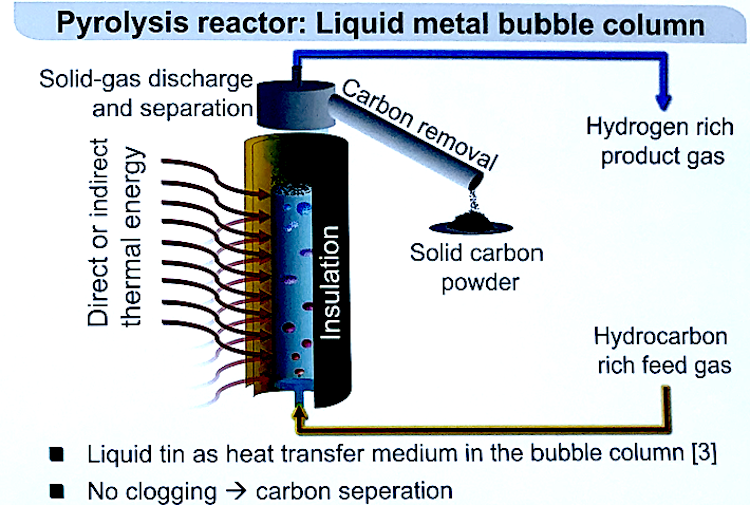
[Liquid metal methane cracking reactor](https://www.solarpaces.org/methane-pyrolysis-with-liquid-metals-in-a-bubble-column-reactor-to-generate-green-hydrogen-and-carbon/)
---
### 1. Atmospheric Liquid-Metal Catalytic CVD (Room-Pressure Epitaxy)
Instead of generating an energy-intensive vacuum plasma to break the strong $\text{C–H}$ bonds of methane ($439\text{ kJ/mol}$), liquid metal alloys act as a low-temperature catalytic solvent.
```
CH₄ Gas Sparging (1 atm)
│
▼
┌─────────────────────────────────────────────────────────┐
│ Liquid Metal Bath: Ga-Ni, Ga-Cu, or Bi-Ni at 750–950°C │
│ 1. Catalytic C-H cleavage at gas-liquid bubble boundary │
│ 2. Atomic C dissolves momentarily into liquid alloy │
│ 3. Liquid metal rejects C to surface / substrate seed │
└─────────────────────────────────────────────────────────┘
│
▼
[ Atmospheric Epitaxial Diamond Film on Seed Crystal / Cores ]
```
* **Process Mechanism:** A molten eutectic mix (such as Gallium–Nickel or Tin–Nickel) held at $800^\circ\text{C} - 950^\circ\text{C}$ in an insulated column cracks methane at atmospheric pressure. The liquid metal provides rapid catalytic cracking while remaining non-coking because carbon has low bulk solubility in gallium and floats to the surface.
* **Why It Cuts Costs:**
* **Ambient Pressure:** Eliminates turbo-molecular pumps, vacuum chambers, and high-vacuum seals.
* **No Plasma Generators:** Replaces multi-kW microwave magnetrons with standard induction or resistive heating coils.
* **Continuous Deposition:** Solid carbon can be continuously collected or directed onto seeded substrates floating at the liquid interface.
---
### 2. High-Efficiency Methane Oxy-Combustion Torches (Atmospheric Flame CVD)
Combustion-flame CVD using a fuel-rich mixture of methane and oxygen is the lowest capital cost method to synthesize diamond films and microcrystals.
$$\text{CH}_4 + \text{O}_2 \longrightarrow \text{CO} + \text{H}_2 + \text{C}^*\ (\text{reactive radicals})$$
* **Operating Mechanism:**
* A standard multi-nozzle oxy-fuel brazing torch is fed with a precise volume ratio of $\text{O}_2 / \text{CH}_4 \approx 0.90 - 0.98$ (fuel-rich).
* The inner primary combustion flame core reaches temperatures of $2800\text{ K}$, dissociating methane into reactive hydrocarbon radicals ($\text{CH}_3^*, \text{CH}_2^*$), atomic carbon, and high concentrations of atomic hydrogen ($\text{H}^*$) and $\text{OH}^*$.
* Directing the inner cone tip onto a water-cooled molybdenum or silicon substrate maintained at $800^\circ\text{C} - 900^\circ\text{C}$ deposits diamond films at **$50\text{–}150\ \mu\text{m/hr}$**—roughly **$10\times$ faster than MPCVD**.
* **Why It Cuts Costs:**
* **Minimal CapEx:** The entire system can be built for under $\$5,000$ using standard gas flow controllers, a water-cooled stage, and welding torches.
* **No Electrical Plasma Demand:** Uses the chemical enthalpy of methane partial oxidation rather than grid electricity.
* **High Radical Flux:** The high atmospheric radical density drives ultrafast linear growth rates.
---
### 3. Two-Step Pyrolysis Loop: Teal Carbon $\rightarrow$ Confined Laser Conversion
Leveraging our prior discussion on methane pyrolysis for carbothermic reduction, this two-step architecture decouples bulk carbon cracking from diamond crystallization:
```
Natural Gas (CH₄)
│
▼ Methane Pyrolysis (Liquid Metal / Induction, 1.0–2.5 kWh/kg C)
┌──────────────────────────────┬──────────────────────────────┐
│ Clean H₂ Gas (Monetized) │ Ultra-Pure Teal Carbon Black │
└──────────────────────────────┴──────────────────────────────┘
│
▼ Disperse in Liquid Carrier + Tamp
┌─────────────────────────────────────────────────────────────┐
│ Low-Watt Laser Shock Compression (fs / ps pulsed) │
│ • Optical breakdown & confined shock (P > 15 GPa) │
│ • Instant sp³ nucleation without graphitic ash traps │
└─────────────────────────────────────────────────────────────┘
│
▼
[ Pure C-H Terminated Nanodiamonds ]
```
* **Why It Cuts Costs:**
* Conventional diamond synthesis from methane suffers from high dilution losses (98% of the gas is vented or recycled unreacted).
* Here, 100% of the methane carbon is captured as solid, ultra-pure carbon black at low energy ($1.0\text{–}2.5\text{ kWh/kg C}$) while producing valuable hydrogen.
* The resulting high-purity, sulfur-free teal carbon is loaded onto a target foil and flashed with a low-watt pulsed laser under quartz/liquid confinement, yielding electronic-grade nanodiamonds without requiring expensive diamondoid precursors or prolonged vacuum runs.
---
### Economic Comparison: Conventional CVD vs. Low-Cost Methane Routes
| Feature | Conventional MPCVD | Atmospheric Liquid-Metal CVD | Oxy-Methane Combustion Flame | Pyrolysis Carbon + Laser Shock |
| :--- | :--- | :--- | :--- | :--- |
| **System CapEx** | High ($\$300\text{k} - \$1\text{M}+$) | Low ($\$15\text{k} - \$35\text{k}$) | **Lowest ($<\$5\text{k}$)** | Moderate ($\$20\text{k} - \$50\text{k}$) |
| **Pressure Regime** | Vacuum ($10 - 40\text{ Torr}$) | **Ambient ($1\text{ atm}$)** | **Ambient ($1\text{ atm}$)** | **Ambient (Confined shock)** |
| **Growth / Conversion Rate** | Slow ($1 - 10\ \mu\text{m/hr}$) | Moderate ($5 - 20\ \mu\text{m/hr}$) | **Fastest ($50 - 150\ \mu\text{m/hr}$)** | Instantaneous shock ($<1\ \mu\text{s}$) |
| **Energy Consumption** | Very high ($40 - 100\text{ kWh/carat}$) | Low ($5 - 15\text{ kWh/carat}$) | Fuel-driven (Oxy-combustion) | **Net negative / low** (Offset by $\text{H}_2$) |
| **Primary Output** | Single-crystal plates / wafers | Polycrystalline films / flakes | Polycrystalline sheets / coatings | Nanodiamond powders ($2 - 5\text{ nm}$) |
---
Powered by [AI Exporter](https://saveai.net)