Gemini_Nanodiamond-Laser-Synthesis-and-2DHG-FETs_20261108-1047
Prompt: 1
message time: 2026-10-26 16:58:16
Review this article and our work on nanodiamonds from low-watt laser:
“On the Conduction Mechanism in Diamond 2-D Hole Gas Field Effect Transistors” | IEEE Journals & Magazine | IEEE Xplore https://ieeexplore.ieee.org/document/11569502
—
Response: 1
Overview of the Paper
“On the Conduction Mechanism in Diamond 2-D Hole Gas Field Effect Transistors” (A. J. Walker, M. S. Hanna, B. Henderson, L. Galambos; IEEE Access, 2026) investigates how carriers move and leak in hydrogen-terminated diamond 2DHG FETs by borrowing core MOS analytical frameworks from silicon:
Silicon-Style Characterization:
Instead of relying primarily on standard Hall effect measurements (which average bulk/surface effects and miss localized trap kinetics), the authors apply quasi-static capacitance–voltage (\(C\)–\(V\)) analysis, effective vertical field (\(E_{\text{eff}}\)) formulation, and Arrhenius barrier extraction.
Temperature-Activated Transport:
Conduction across the full \(V_{GS}\) sweep is thermally activated. This behavior resembles disordered or non-crystalline channel devices rather than ideal single-crystal inversion layers, highlighting that surface disorder, atmospheric adsorbates, and interface traps dominate over pure phonon scattering.
Trap States and Mobility Degradation:
The effective vertical electric field pulls holes tight against the interface. A large fraction of injected carriers become trapped in interfacial states, drastically reducing effective mobile carrier mobility.
Leakage Mechanisms (GIDL Analogs):
The study reports a gate-induced drain leakage (GIDL)-like mechanism, surprising in intrinsically undoped diamond substrates, caused by high localized band bending and trap-assisted tunneling near drain-gate overlap zones.
Connecting to Nanodiamonds Synthesized via Low-Watt Laser
Synthesizing nanodiamonds (NDs) using low-wattage lasers (e.g., pulsed or continuous-wave liquid-phase laser ablation/transformation) produces particles with distinct surface and structural characteristics. Looking at that synthesis method through the lens of this IEEE paper reveals key intersections:
Low-Watt Laser Nanodiamonds                     Walker et al. (IEEE 2026)
  • High surface-to-volume ratio                  • Surface transfer doping / 2DHG
  • Complex surface termination (C-H, C-O, sp²)   • Interface trap states & mobility degradation
  • Defect / grain boundaries                     • Thermally activated hopping conduction
1. Surface Chemistry & Transfer Doping
Paper’s context: Diamond 2DHG formation relies strictly on hydrogen termination coupled with surface transfer doping (electron transfer from the diamond valence band to surface adsorbates/dielectrics).
Low-watt laser context: Low-watt laser synthesis in liquid media (water, ethanol, organic precursors) typically leaves a heterogeneous surface containing mixed \(sp^2/sp^3\) carbon, carbonyls, hydroxyls, and hydrogen bonds. To leverage or evaluate 2DHG effects in films assembled from these NDs, precise post-processing (e.g., hydrogen plasma annealing) is required to remove graphitic \(sp^2\) shells and enforce pure C–H termination.
2. Interface Traps vs. Nanocrystalline Grain Boundaries
Paper’s context: Walker et al. demonstrate that carrier mobility in 2DHG FETs is bottlenecked by interface state trapping rather than bulk lattice scattering, showing temperature-activated conduction characteristic of disordered interfaces.
Low-watt laser context: If your low-watt laser process is used to grow seeded diamond layers or assemble thin-film channels, the grain boundaries and defect density inherent to laser-synthesized NDs will dramatically increase the density of localized trap states (\(D_{it}\)). Conduction across such films will likely follow variable-range hopping (VRH) or nearest-neighbor hopping rather than 2D band transport.
3. Electric Field Concentration and Leakage
Paper’s context: The unexpected GIDL-like leakage observed in single-crystal/bulk slices stems from high local field-assisted carrier emission at interface traps.
Low-watt laser context: In nanodiamond-based composite films or seeded layers, local field enhancement around sharp nanoparticle geometries and boundary graphitic clusters will exacerbate trap-assisted tunneling, making field-dependent dielectric leakage a major hurdle for high-voltage switching.
Potential Research Directions & Synergies
Focus Area |
Challenge Identified in Paper |
Opportunity for Low-Watt Laser Nanodiamonds |
|---|---|---|
Surface Passivation |
Adsorbate-based 2DHG is unstable over time and sensitive to thermal cycling. |
Laser-assisted surface photochemical functionalization to graft stable acceptor groups onto diamond surfaces without requiring air adsorbates. |
Seeding & Thin Films |
High substrate cost (\(2+\) carat single crystals) limits widespread commercial adoption. |
Using laser-derived NDs as ultra-clean nucleation seeds for wafer-scale heteroepitaxial diamond growth on silicon/sapphire. |
Defect Spectroscopy |
\(C\)–\(V\) and Arrhenius methods revealed dense mid-gap states. |
Applying the paper’s low-noise quasi-static \(C\)–\(V\) extraction techniques to directly quantify the electronic trap density of laser-treated ND films. |
Prompt: 2
message time: 2026-10-26 16:59:46
How do low-watt laser synthesis parameters like liquid medium, pulse duration, and wavelength impact diamond surface termination and electrical properties?
—
Response: 2
In low-watt laser synthesis in liquids—such as laser ablation in liquids (LAL) or the laser-driven conversion of diamondoid precursors (adamantane, aza-adamantane, carbon targets)—nanodiamond (ND) nucleation occurs inside a confined, high-pressure, high-temperature plasma plume. The parameters governing the laser and its surrounding medium directly dictate the resulting surface chemistry, \(sp^2/sp^3\) ratio, and downstream electrical conduction mechanisms.

Laser ablation in solution setup
1. Liquid Medium: Chemical Termination & Surface Doping
The liquid surrounding the focal zone provides the confining inertia that raises plasma shock pressures into the diamond stability window (\(P > 10\text{ GPa}\), \(T > 3000\text{ K}\)), while its molecular dissociation products chemically terminate the hot particle surfaces.
Deionized Water (\(H_2O\)):
Surface Chemistry: Thermal and plasma dissociation yields abundant \(\cdot OH\), \(\cdot H\), and \(O^{2-}\) radicals. The resulting ND surfaces are dominated by hydroxyl (\(-OH\)), carboxyl (\(-COOH\)), and cyclic ether/lactone groups.
Electrical Impact: Oxygen termination produces a positive electron affinity (\(\chi > 0\)), deep hole traps, and high surface resistivity. It suppresses surface transfer doping, eliminating any intrinsic 2-D hole gas (2DHG) channel and yielding purely insulating particles (\(R > 10^{12}\ \Omega\)).
Alcohols and Hydrocarbons (Ethanol, Toluene, Hexane, Adamantane solutions):
Surface Chemistry: Solvent dissociation generates rich active carbon and hydrogen species with minimal oxygen. This preferentially stabilizes \(C\text{–}H\) termination while depositing an ultrathin graphitic/amorphous carbon (\(sp^2\)) shell around the \(sp^3\) core during the cavitation quench.
Electrical Impact: Pure C–H termination lowers the diamond work function and induces negative electron affinity (NEA, \(\chi \approx -1.3\text{ eV}\)). When exposed to ambient air or molecular acceptors, this enables surface transfer doping and 2DHG formation. However, incomplete graphitic shell removal leads to unwanted parallel \(sp^2\) leakage pathways.
Nitrogen-Containing Solvents (Acetonitrile, Liquid \(N_2\), or dissolved Aza-adamantane):
Surface Chemistry: In-situ incorporation of nitrogen defects (\(N_V^0, N_V^-\), and substitutional \(P1\) centers) along with surface amino (\(-NH_2\)) and nitrile (\(-C\equiv N\)) terminations.
Electrical Impact: Substitutional nitrogen acts as a deep donor (\(E_d \approx 1.7\text{ eV}\) below the conduction band), pinning the Fermi level near mid-gap and increasing bulk trap-assisted tunneling barriers.
2. Pulse Duration: Thermal Partitioning vs. Defect Density
Pulse duration controls the balance between non-thermal photochemical bond-breaking and localized thermal heating.
Regime |
Synthesis Physics |
Surface & Interface Structure |
Electrical Conduction Impact |
|---|---|---|---|
Femtosecond / Picosecond |
Non-thermal phase explosion. Peak intensities exceed \(10^{13}\text{ W/cm}^2\) even at low average wattages. Fast optical breakdown outpaces thermal diffusion. |
Minimal \(sp^2\) reconstruction. Extremely fast quenching rates (\(>10^{11}\text{ K/s}\)) freeze the high-pressure diamond phase with sharp interfaces and thin graphitic boundaries. |
Steep Subthreshold Slopes & Low GIDL. Interface trap density (\(D_{it}\)) at grain boundaries is minimized. Minimizes the trap-assisted tunneling and gate-induced drain leakage (GIDL) described by Walker et al. |
Nanosecond |
Plasma heating & shock confinement. The laser pulse continues to heat the expanding plasma plume; cavitation bubbles linger longer (\(10\text{–}100\ \mu\text{s}\)). |
Thick \(sp^2\) fullerene/graphitic shells. Slower cooling permits surface graphitization of the metastable \(sp^3\) core via surface reconstruction. |
Hopping Conduction. Conduction across films of these NDs is dominated by variable-range hopping (VRH) through localized graphitic states rather than 2D band transport. |
3. Laser Wavelength: Optical Penetration & In-Flight Annealing
The choice of laser wavelength governs absorption efficiency in the precursor target, the solvent’s transmission window, and secondary photo-induced remodeling of suspended nanoparticles.
Ultraviolet (DUV / UV: 213 nm – 355 nm):
Interaction Mechanism: Photon energies (\(3.5\text{–}5.8\text{ eV}\)) directly match the electronic bandgaps of hydrocarbons and diamondoid precursors, driving direct single-photon photochemical cleavage over purely thermal ablation.
Electrical & Structural Impact: Minimizes graphitization and selectively photo-etches surrounding \(sp^2\) carbon shells (\(C=C\) \(\pi\text{–}\pi^*\) transitions absorb strongly in the UV). This yields high-purity \(sp^3\) grains with low structural defect densities and lower trap states near the band edges.
Near-Infrared (NIR: 1064 nm):
Interaction Mechanism: Absorption relies heavily on multi-photon ionization or pre-existing seed absorption (free-carrier and inverse Bremsstrahlung absorption).
Electrical & Structural Impact: Secondary interaction between the trailing beam and previously synthesized nanoparticles heats the dispersed colloids, often causing thermal annealing that increases grain size but thickens the surrounding \(sp^2\) graphitic boundary. This enhances film conductivity while lowering overall carrier mobility.
Synthesis-to-Device Design Map
To optimize low-watt laser-synthesized diamond for stable electronic devices and avoid the severe trapping mechanisms highlighted in recent 2DHG studies:
For 2DHG FET Channels: Use short pulses (fs/ps) in a hydrocarbon/alcohol medium to maximize \(C\text{–}H\) termination and prevent thermal graphitization, followed by selective UV oxidation or gentle etching to strip boundary \(sp^2\) states.
For High-Voltage Dielectric Buffers / Insulators: Use a water-based medium under UV exposure to generate complete, high-barrier oxygen termination (\(-O-\), \(-OH\)), suppressing leakage and eliminating transfer-doped conductive channels.
Prompt: 3
message time: 2026-10-26 17:00:16
What are the best chemical and thermal post-synthesis methods to remove sp2 graphitic shells from laser-synthesized nanodiamonds without damaging C-H surface termination?
—
Response: 3
Selective removal of external \(sp^2\) graphitic/amorphous carbon shells from nanodiamonds (NDs) while preserving or cleanly re-establishing pure \(C\text{–}H\) termination presents a strict thermodynamic challenge: \(sp^2\) stripping agents (like strong oxidizers or air) preferentially oxygenate the diamond surface into \(-OH\), \(-COOH\), or \(C=O\) species.
To retain or restore pristine \(C\text{–}H\) termination, the process requires either a direct selective dry-gas reduction/etch or a controlled oxidation followed by immediate dry hydrogenation.
1. Direct Hydrogen Plasma Etching (Single-Step Benchmark)
Microwave-plasma or inductively coupled remote-plasma chemical vapor deposition (MPCVD / ICP-CVD) systems operating in pure \(H_2\) are the standard for single-step \(sp^2\) removal and concurrent \(C\text{–}H\) saturation.
       [Graphitic sp² Shell + Diamond sp³ Core]
                         │
                         ▼  H* Radicals (Atomic Hydrogen)
        ┌───────────────────────────────────┐
        │ 1. sp² Etch: C(sp²) + 4H* ──► CH₄ │ (Etch rate: sp² >> sp³)
        │ 2. sp³ Passivation: C(sp³) ──► C-H│ (NEA, 2DHG preserved)
        └───────────────────────────────────┘
                         │
                         ▼
        [Pristine C-H Terminated Nanodiamond Core]
Mechanism: High-density atomic hydrogen radicals (\(H^*\)) selectively gasify \(sp^2\) carbon to methane (\(CH_4\)) at rates 2 to 3 orders of magnitude faster than diamond \(sp^3\) etching: $\(C(sp^2) + 4H^* \longrightarrow CH_4\ (\text{gas})\)$ Simultaneously, active hydrogen atoms saturate open dangling bonds on the exposed diamond facet, stabilizing the (111) and (100) surfaces into monohydride and dihydride terminations.
Process Parameters:
Substrate Temperature: \(600^\circ\text{C} - 750^\circ\text{C}\) (temperatures above \(800^\circ\text{C}\) risk spontaneous diamond surface graphitization in vacuum; below \(500^\circ\text{C}\), the \(sp^2\) etch rate is too slow).
Chamber Pressure: \(20 - 40\text{ Torr}\) pure \(H_2\) (forming gas \(95\%\ N_2 / 5\%\ H_2\) is avoided to prevent nitrogen insertion or amine termination).
Microwave/RF Power: Moderate power (\(500 - 800\text{ W}\)) or remote downstream configuration to prevent ion bombardment damage and sputtering of the nanodiamond cores.
2. Low-Temperature Catalytic Hydrogasification (Thermal Tube Furnace)
When microwave plasma is unavailable, atmospheric or low-pressure thermal annealing in pure hydrogen cannot sufficiently crack molecular \(H_2\) below \(800^\circ\text{C}\). Introducing trace transition metal nanoparticle catalysts enables low-temperature selective stripping.
Mechanism: Nanoparticles of transition metals (e.g., Ni, Co, Fe, or Ru) or transition-metal-doped substrates act as catalytic dissociation sites for \(H_2 \rightarrow 2H^*\). These activated species migrate via hydrogen spillover to dissolve and gasify disordered \(sp^2\) carbon into volatile hydrocarbons at temperatures far below bulk diamond degradation thresholds.
Process Parameters:
Atmosphere: High-purity \(H_2\) (\(99.999\%\)) or forming gas (\(95\%\ Ar / 5\%\ H_2\)).
Temperature: \(450^\circ\text{C} - 550^\circ\text{C}\).
Cycle: 1–2 hours. The sacrificial trace metal catalyst is subsequently removed via mild, non-oxidizing dilute \(HCl\) acid washing (which leaves \(C\text{–}H\) bonds intact, unlike nitric or sulfuric acid).
3. Two-Step Decoupled Route: Selective Air/Ozone Etch \(\rightarrow\) Pure \(H_2\) Thermal Passivation
Liquid-phase acid baths (e.g., boiling perchloric/nitric/sulfuric tri-acid mixtures) aggressively strip graphitic shells, but they replace them with complex polyfunctional oxygen layers (hydroxyl, carboxyl, anhydride) that resist complete reduction. A cleaner approach decouples \(sp^2\) removal from hydrogen termination using dry-phase processing:
Step |
Technique |
Target Reaction |
Surface State |
|---|---|---|---|
Step 1: Selective Strip |
Controlled Air / Ozone Oxidation |
Graphitic carbon oxidizes to \(CO/CO_2\) at \(\sim 420^\circ\text{C}\), whereas single-crystal diamond resists thermal oxidation in air up to \(\sim 550^\circ\text{C} - 600^\circ\text{C}\). |
Fully oxygen-terminated diamond core (\(-O-\), \(-C=O\), \(-OH\)). No residual \(sp^2\) boundary. |
Step 2: Dry Reduction |
High-Temperature Molecular \(H_2\) Anneal |
Desorbs surface oxygen species (\(H_2O\) and \(CO\) elimination) and saturates open surface sites with atomic/molecular hydrogen without introducing plasma damage. |
Pure \(C\text{–}H\) termination, negative electron affinity, restored 2DHG transfer-doping capability. |
Process Verification & Quality Metrics
To verify that the \(sp^2\) shell is eliminated without compromising the \(C\text{–}H\) surface:
Raman Spectroscopy (\(532\text{ nm}\) and UV \(244\text{ nm}\)):
Target: Disappearance of the broad \(D\)-band (\(\sim 1350\text{ cm}^{-1}\)) and \(G\)-band (\(\sim 1580\text{ cm}^{-1}\)), leaving only the sharp \(sp^3\) diamond phonon line at \(1332\text{ cm}^{-1}\). (UV Raman is especially sensitive to the \(sp^3\) phase).
FTIR / ATR Spectroscopy:
Target: Vanishing of the \(C=O\) carbonyl stretch (\(1720 - 1780\text{ cm}^{-1}\)) and \(C-O-C\) ether bands (\(1100 - 1300\text{ cm}^{-1}\)); strong emergence of symmetric and asymmetric \(C\text{–}H_x\) stretches in the \(2820 - 2960\text{ cm}^{-1}\) window.
X-ray Photoelectron Spectroscopy (XPS):
Target: Narrowing of the \(C 1s\) peak toward \(\sim 284.0\text{ eV}\) with negligible oxygen contribution (\(O 1s < 1\text{ at}\%\)).
Prompt: 4
message time: 2026-10-26 17:00:50
Can these be made from lignin? Plastic?
—
Response: 4
Nanodiamonds can be synthesized directly from both lignin and plastics (polymers) using low-watt laser conversion. In fact, polymers and aromatic bio-macromolecules serve as high-yield solid carbon precursors because they supply both the dense carbon backbone and localized hydrogen/confinement needed during the laser-induced shock transformation.
1. Synthesizing Nanodiamonds from Lignin
Lignin is an aromatic, highly cross-linked polyphenolic network (guaiacyl, syringyl, and \(p\)-hydroxyphenyl units).
Mechanism & Precursor Chemistry:
When subjected to focused laser pulses (pulsed NIR or UV), lignin undergoes rapid localized photothermal pyrolysis and photo-fragmentation.
Unlike pristine graphite, lignin carries a high concentration of native hydrogen (aliphatic and phenolic C–H) and ether linkages (C–O–C). Under laser-induced shock compression in a liquid or confined boundary, the high local carbon density and thermal decomposition create a carbon-supersaturated plasma that nucleates \(sp^3\) diamond cores (\(2\text{–}10\text{ nm}\)).
Precursor Optimization:
Ash/Mineral Contaminants: Commercial Kraft lignin contains trace sulfur (\(1\text{–}3\%\)) and inorganic salts (sodium, silica, ash), which act as parasitic absorption centers or introduce metallic/sulfur trap states into the diamond lattice. Utilizing de-ashed Organosolv lignin (\(<0.1\%\) ash) is essential for producing electronic-grade nanodiamonds.
Processing Geometry: Liquid suspension (lignin nanoparticles dispersed in ethanol or water) or spin-coated thin films sandwiched under a confining transparent overlay (e.g., quartz or sapphire) to maximize the peak shock pressure above the \(10\text{ GPa}\) diamond stability line.
2. Synthesizing Nanodiamonds from Plastics
Plastics are effective precursors for laser synthesis, with conversion dynamics dictated primarily by the polymer’s chemical backbone.
                  Laser Pulse (fs, ps, ns)
                             │
                             ▼
 ┌────────────────────────────────────────────────────────┐
 │ Hydrocarbon Plastics (PET, PS, PE, PI) + Confinement   │
 └────────────────────────────────────────────────────────┘
                             │
                             ▼  High P (>10 GPa), High T (>3500 K)
 ┌────────────────────────────────────────────────────────┐
 │   1. Photochemical Backbone Cleavage                   │
 │   2. Carbon/Hydrogen Plasma Cavitation Quench          │
 │   3. sp³ Nucleation & Rapid Freezing (<10¹¹ K/s)       │
 └────────────────────────────────────────────────────────┘
                             │
                             ▼
            [ sp³ Core with Native C-H Passivation ]
Polyethylene Terephthalate (PET):
PET (\(\text{C}_{10}\text{H}_8\text{O}_4\)) has an ideal stoichiometry of carbon, hydrogen, and oxygen. Laser shock compression experiments (including planetary-analogy studies) demonstrate that oxygen accelerates phase separation between carbon and hydrogen, promoting spontaneous diamond precipitation while oxygen binds excess hydrogen as \(\text{H}_2\text{O}\).
Polystyrene (PS) & Polyimide (PI):
Aromatic rings provide high carbon yield (\(sp^2\)-dense structures that collapse efficiently into \(sp^3\) networks under shock). Polyimide’s strong optical absorption across UV and mid-IR facilitates low-threshold breakdown even at low laser wattages.
Aliphatic Polyolefins (PE, PP):
Saturated polymers (\(\text{–CH}_2\text{–CH}_2\text{–}\)) deliver a high \(\text{H/C}\) ratio (\(2:1\)). Laser ablation of polyethylene in liquid or confined geometries produces high-purity \(C\text{–}H\) passivated NDs, as the excess hydrogen directly caps dangling surface bonds during the quenching plume, preventing extensive graphitic shell formation.
Comparative Evaluation: Lignin vs. Plastics vs. Traditional Graphite
Metric / Parameter |
Lignin Precursors |
Synthetic Plastics (PET, PS, PE) |
Traditional Solid Carbon (Graphite / Glassy Carbon) |
|---|---|---|---|
Laser Absorption Threshold |
Moderate to High (natural chromophores, phenolic absorption in UV/VIS) |
Polymer-dependent (high in PI/PET; low in pure PE without UV/dopants) |
Low (very high optical absorption across all wavelengths) |
In-Situ Hydrogen Availability |
Moderate (phenolic/aliphatic \(H\) present) |
Very High (built-in \(C\text{–}H_x\) groups promote direct hydrogen passivation) |
Negligible (requires external liquid medium like ethanol or \(\text{H}_2\text{O}\)) |
Purity & Defect Profile |
Contains native \(O\), trace \(N\), and potential ash/S; yields functionalized NDs |
Predictable; pure hydrocarbon or oxy-hydrocarbon lattices |
High elemental purity, but high graphitic boundary fraction |
Post-Synthesis Cleaning |
Requires mild catalytic stripping or clean \(\text{H}_2\) anneal to remove bio-char |
Easier removal of aliphatic residues via low-temperature thermal desorptions |
Heavy \(sp^2\) graphitic/fullerene shell needs intense plasma etching |
Relevance to Electronic Devices (2DHG FETs)
Connecting back to the conduction and trapping mechanisms from Walker et al.:
Direct \(C\text{–}H\) Retention: Using hydrogen-rich polymers (PE, PS) or high-hydrogen lignin fractions under laser ablation reduces the thickness of the outer graphitic shell. This allows the particles to maintain higher native hydrogen termination without requiring destructive acid boiling.
Impurity Trapping: Lignin-derived NDs must be thoroughly purified to avoid deep sulfur and transition-metal traps that would otherwise degrade carrier mobility and increase gate-induced leakage in 2DHG devices. Polyolefin- or PET-derived nanodiamonds offer an electrically cleaner, highly reproducible baseline for semiconductor seeding and thin-film transistor channels.
Prompt: 5
message time: 2026-10-26 17:01:45
Yes, both
—
Response: 5
An engineered low-watt laser conversion setup translates de-ashed Organosolv lignin and PET/aliphatic plastics into high-purity nanodiamonds (NDs) through laser shock compression, photochemical bond breaking, and tailored confinement geometries.
Part 1: Laser Parameters & Confinement Geometry for PET & Lignin
Converting polymers or bio-macromolecules into nanodiamonds via low average-power lasers requires decoupling peak pulse intensity (for shock-wave generation and non-thermal bond breaking) from average thermal load (to prevent graphitization of the metastable \(sp^3\) phase).
                         Focused Laser Beam
                      (fs / ps Pulsed NIR or UV)
                                 │
                                 ▼
   ┌────────────────────────────────────────────────────────────┐
   │ Transparent Confinement Overlay (Quartz, Fused Silica)     │
   ├────────────────────────────────────────────────────────────┤  Shock Wave
   │ Sacrificial Ablation / Plasma Layer (Water or Cryo-Alcohol)│  P > 10–25 GPa
   ├────────────────────────────────────────────────────────────┤  T > 3000–4500 K
   │ Precursor Layer: PET Film / De-ashed Organosolv Lignin     │
   ├────────────────────────────────────────────────────────────┤
   │ Substrate (Silicon, Sapphire, or Heat-Sink Cu)             │
   └────────────────────────────────────────────────────────────┘
1. Confinement Geometries
Direct surface ablation in ambient air merely yields laser-induced graphene (LIG) or bio-char because the plasma plume expands freely, capping transient pressure below \(0.1\text{ GPa}\). To achieve the \(>10\text{–}25\text{ GPa}\) required for the diamond phase boundary:
Planar Confined-Shock Geometry (Thin Film Target):
Spin-coat a dense film (\(1\text{–}5\ \mu\text{m}\)) of purified Organosolv lignin (solvated in DMF/ethanol) or a biaxially oriented PET film onto a rigid substrate (e.g., Sapphire or Si).
Cover with an optically transparent inertial tamper layer (fused silica or quartz slide, \(1\text{–}2\text{ mm}\) thick) with an ultrathin liquid boundary (water or ethanol film, \(10\text{–}50\ \mu\text{m}\)) sandwiched in between.
The transparent tamping layer prevents rapid volume expansion, forcing the plasma recoil pressure to exceed \(20\text{ GPa}\) for hundreds of picoseconds.
Liquid-Suspension Micro-Cavitation (Colloidal Target):
Sub-micron particles of Organosolv lignin or PET nanosuspensions are dispersed in a liquid cell (deionized water or ethanol) equipped with a magnetic stirrer or microfluidic flow channel.
A high-numerical-aperture objective focuses the beam into the liquid. Optical breakdown creates a cavitation bubble whose inertial collapse adds secondary acoustic shock pressure to the nanosecond/picosecond optical plasma.
2. Wavelength, Pulse Duration, and Fluence Windows
Parameter |
Recommended Window |
Mechanism & Role |
|---|---|---|
Laser Pulse Duration |
Femtosecond (fs): \(100 - 350\text{ fs}\) |
fs pulses deliver peak power densities \(>10^{13}\text{ W/cm}^2\) even at low average wattages (\(1 - 5\text{ W}\)), bypassing linear thermal diffusion. It induces a pure non-thermal Coulomb explosion and ultrafast phase transition before thermal graphitization can occur. |
Wavelength |
DUV/UV (266 nm or 355 nm) |
UV photons (\(3.5\text{–}4.66\text{ eV}\)) directly match the aromatic absorption bands of lignin (phenolic chromophores) and PET (\(\pi\text{–}\pi^*\) transitions), facilitating single-photon photochemical cleavage of C–C and C–O bonds. |
Fluence |
\(1.5 - 4.5\text{ J/cm}^2\) (focused) |
Operates strictly above the optical ablation/shock threshold (\(\sim 1.0\text{ J/cm}^2\)), but well below the excessive thermal heating regime (\(>8\text{ J/cm}^2\)) that vaporizes carbon or stabilizes graphite. |
Repetition Rate |
\(1\text{ kHz} - 100\text{ kHz}\) |
Low duty cycle minimizes cumulative substrate heating. High scan speeds (\(100 - 500\text{ mm/s}\)) prevent multi-pulse thermal accumulation on previously formed nanodiamond seeds. |
Part 2: Laser-Induced Shock-Compression & Yield in PET
PET (\(\text{C}_{10}\text{H}_8\text{O}_4\)) is an efficient solid-state precursor for laser-driven diamond precipitation due to its specific elemental stoichiometry and phase-separation dynamics under extreme conditions.
       [ PET Backbone: -O-CH₂-CH₂-O-CO-C₆H₄-CO- ]
                           │
                           ▼  Laser Shock (P > 15 GPa, T ~ 4000 K)
       ┌─────────────────────────────────────────────────────────┐
       │ Rapid Photo-Chemical Homolysis (C-C, C-O, C-H Bonds)   │
       └─────────────────────────────────────────────────────────┘
                           │
                           ▼  Fast Demixing / Phase Separation
       ┌───────────────────────────────┬─────────────────────────┐
       │ Dense Supercritical C-Fluid   │ Water / Volatile Fluid  │
       │ Carbon supersaturation        │ Oxygen captures H       │
       │ Rapid sp³ crystallization     │ Forms high-P H₂O / CO   │
       └───────────────────────────────┴─────────────────────────┘
                           │
                           ▼  Quenching (<10¹¹ K/s)
            [ Nanodiamond Crystallites (2–5 nm) ]
Endogenous Oxygen-Driven Phase Demixing:
In pure hydrocarbon polymers (e.g., polystyrene), carbon-hydrogen separation under shock requires pressures exceeding \(25\text{–}30\text{ GPa}\).
In PET, the built-in oxygen atoms chemically bind with hydrogen, forming superionic/supercritical \(\text{H}_2\text{O}\) (and volatile \(\text{CO}/\text{CO}_2\)). This drives spontaneous phase separation between water and carbon at lower pressures (\(15\text{–}20\text{ GPa}\)), precipitating pristine carbon clusters that freeze into \(sp^3\) diamond crystallites (\(2\text{–}5\text{ nm}\)).
Yield Expectations & Collection:
Mass Conversion Efficiency: In planar confined-shock geometries, local carbon-to-diamond mass conversion within the focal interaction volume reaches \(15\text{–}35\%\). Unconverted material forms an outer graphitic skin and aliphatic fragments.
Purity: Because pure commercial optical-grade PET has undetectable mineral ash and virtually zero sulfur or transition metals, the core \(sp^3\) lattice is free of deep-level metallic traps, making it suitable for clean semiconductor seeding.
Part 3: Organosolv vs. Kraft Lignin for Carbon Nanomaterials
The structural and chemical composition of technical lignins directly dictates the purity, defect profile, and processing efficiency of the resulting diamond nanoparticles.
Feature / Metric |
Organosolv Lignin |
Kraft Lignin |
Technical Impact on Nanomaterial Synthesis |
|---|---|---|---|
Ash / Mineral Content |
Ultra-low (\(< 0.1\text{ wt}\%\)) |
High (\(1.5 - 5.0\text{ wt}\%\)) |
Kraft contains inorganic \(\text{Na}_2\text{SO}_4\), \(\text{Na}_2\text{CO}_3\), and \(\text{SiO}_2\). These minerals vaporize under the laser beam, creating optical micro-arcing and introducing ionic charge traps into the diamond film. |
Sulfur Content |
\(0.0\text{ wt}\%\) (Sulfur-free) |
\(1.5 - 3.5\text{ wt}\%\) |
Sulfur integrates into the carbon lattice as a localized deep-level trap, causing severe trap-assisted tunneling and degrading subthreshold swing in 2DHG FETs. |
Solubility & Purity |
Readily soluble in green organic solvents (ethanol, acetone, DMF) |
Poorly soluble in organics; requires alkaline water (\(\text{pH} > 11\)) |
Organosolv forms uniform, optically flat spin-coated films with homogeneous optical absorption, preventing localized pinholes and irregular laser ablation. |
Molecular Structure & \(M_w\) |
Low molecular weight (\(M_w \approx 1000 - 3000\text{ g/mol}\)), narrow polydispersity, high retention of \(\beta\text{-O-}4\) ether linkages |
High molecular weight (\(M_w \approx 3000 - 10000\text{ g/mol}\)), heavily cross-linked, high C–C condensed bonds |
Intact ether linkages in Organosolv cleave cleanly under UV/photons, whereas Kraft’s condensed polyaromatic core favors broad graphitic bio-char rather than nanodiamond nucleation. |
Practical Processing Workflow
   Raw Lignin / Polymer Precursor
                 │
                 ▼
 ┌──────────────────────────────────────────────────────────┐
 │ Step 1: Precursor Purification                           │
 │ • For Lignin: De-ashed Organosolv (<0.1% ash, 0% S)      │
 │ • For Plastic: Biaxially oriented PET film               │
 └──────────────────────────────────────────────────────────┘
                 │
                 ▼
 ┌──────────────────────────────────────────────────────────┐
 │ Step 2: Laser Confined Shock Conversion                  │
 │ • fs/ps pulsed laser (1030 nm or 355 nm UV)              │
 │ • Fluence: 2.0–3.5 J/cm² under quartz + liquid tamping   │
 │ • Shock pressure > 15 GPa nucleates 2–5 nm sp³ cores     │
 └──────────────────────────────────────────────────────────┘
                 │
                 ▼
 ┌──────────────────────────────────────────────────────────┐
 │ Step 3: Gas-Phase Surface Conditioning                   │
 │ • Pure H₂ microwave plasma (650°C, 30 Torr)             │
 │ • Strips sp² boundary shell -> CH₄ (gas)                 │
 │ • Generates pure C-H passivation (NEA, 2DHG ready)       │
 └──────────────────────────────────────────────────────────┘
Using purified Organosolv lignin or pure PET inside an optically confined, liquid-tamped geometry resolves the defect challenges identified in the Walker et al. 2DHG device studies. It prevents inorganic contamination, reduces the \(sp^2\) grain boundary volume, and preserves native surface hydrogen bonds needed for stable electronic transport.
Prompt: 6
message time: 2026-10-26 17:29:02
Yes, both
—
Response: 6
1. Ultrasonic & Solvent-Fractionation De-Ashing of Kraft Lignin
Technical Kraft lignin typically carries \(1.5\text{–}5.0\text{ wt}\%\) inorganic salts (\(\text{Na}_2\text{SO}_4\), \(\text{Na}_2\text{CO}_3\), sodium silicates, and residual bound sulfur). To achieve the purity required for clean laser-driven diamond transformation, an acid-assisted ultrasonic leaching protocol coupled with sequential solvent fractionation removes ionic ash and low-molecular-weight sulfur compounds.
       [ Raw Kraft Lignin (~3% Ash, 2% S) ]
                        │
                        ▼  0.1 M HCl / Ultrasonication (40 kHz, 45°C)
       ┌─────────────────────────────────────────────────────────┐
       │ Step 1: Acid Leaching & Desalination                    │
       │ Dissolves Na⁺, SO₄²⁻, and mineral silicates into water  │
       └─────────────────────────────────────────────────────────┘
                        │
                        ▼  Deionized H₂O Wash until Cond. < 5 µS/cm
       [ Desalted Lignin Cake (<0.2% Ash) ]
                        │
                        ▼  Selective Extraction: Acetone/Ethanol (9:1)
       ┌─────────────────────────────────────────────────────────┐
       │ Step 2: Solvent Fractionation                           │
       │ Insoluble high-ash inorganics & char remain in pellet;  │
       │ High-purity, uniform-Mw lignin dissolves in liquor      │
       └─────────────────────────────────────────────────────────┘
                        │
                        ▼  Rotovap + Vacuum Dry (40°C, 10⁻² mbar)
       [ Semiconductor-Grade Lignin (<0.04% Ash, <0.2% S) ]
Step-by-Step Laboratory Protocol
Acid-Assisted Ultrasonic Leaching:
Slurry raw Kraft lignin at \(5\text{ wt}\%\) solid loading in \(0.1\text{ M}\ \text{HCl}\) prepared with Milli-Q water (\(18.2\text{ M}\Omega\cdot\text{cm}\)).
Subject the suspension to probe or bath ultrasonication (\(20\text{–}40\text{ kHz}\), \(250\text{ W}\)) for 45 minutes at \(45^\circ\text{C}\). Acoustic cavitation collapses micro-agglomerates, exposing entrapped salt crystallites and accelerating ion dissolution into the aqueous phase.
Centrifugation & Conductivity-Monitored Washing:
Centrifuge the suspension at \(6000\times g\) for 15 minutes to pellet the insoluble desalted lignin. Decant the supernatant.
Resuspend the pellet in pure Milli-Q water and repeat centrifugation until the electrical conductivity of the supernatant falls below \(5\ \mu\text{S/cm}\) (typically 3–4 wash cycles).
Selective Solvent Extraction (Solvent Fractionation):
Dry the desalted cake under vacuum at \(50^\circ\text{C}\) overnight.
Dissolve the dry cake in an analytical-grade acetone/absolute ethanol mixture (\(9:1\ \text{v/v}\)) at a concentration of \(100\text{ g/L}\).
Stir for 2 hours, then centrifuge at \(8000\times g\) for 20 minutes. High-molecular-weight inorganic ash condensates remain insoluble in the pellet.
Filtration & Isolation:
Pass the supernatant through a \(0.22\ \mu\text{m}\) PTFE membrane filter.
Evaporate the solvent on a rotary evaporator at \(40^\circ\text{C}\) under reduced pressure, followed by vacuum drying at \(60^\circ\text{C}\) (\(10^{-2}\text{ mbar}\)) for 24 hours.
Target Purity: ICP-OES / XRF analysis confirms total ash \(< 0.04\text{ wt}\%\) and total sulfur \(< 0.2\text{ wt}\%\).
2. Spin-Coating Protocol for 1-Micron Target Films
Achieving high diamond conversion yields in confined-shock geometries requires an optically uniform, pinhole-free target film with controlled surface roughness (\(R_a < 2\text{ nm}\)) to ensure uniform acoustic coupling with the confining tamp.
       Purified Organosolv / De-Ashed Lignin
                        │
                        ▼  Dissolve in Anisole/Ethanol (4:1) at 14 wt%
       ┌─────────────────────────────────────────────────────────┐
       │ Solution Preparation: Sonicate (15 min) + 0.2 µm PTFE   │
       └─────────────────────────────────────────────────────────┘
                        │
                        ▼  Spin onto Sapphire / Si Substrate
       ┌─────────────────────────────────────────────────────────┐
       │ Spin-Coat Recipe:                                       │
       │ • Spread: 500 RPM (6 s, 300 RPM/s)                      │
       │ • Spin:   2800 RPM (45 s, 1500 RPM/s)                   │
       └─────────────────────────────────────────────────────────┘
                        │
                        ▼  Two-Stage Hotplate Bake
       ┌─────────────────────────────────────────────────────────┐
       │ • Soft Bake:  65°C (3 min)   -> Gentle solvent escape   │
       │ • Hard Bake: 110°C (10 min)  -> Cross-linking & drying │
       └─────────────────────────────────────────────────────────┘
                        │
                        ▼
       [ 1.05 ± 0.03 µm Uniform Target Film (Ra < 1.8 nm) ]
Detailed Fabrication Recipe
Solvent System & Formulation:
Solvent: Anisole / Absolute Ethanol mixture (\(80:20\ \text{v/v}\)). Anisole provides an elevated boiling point (\(154^\circ\text{C}\)) to suppress premature Marangoni drying rings, while ethanol lowers surface tension to promote wetting on sapphire/silicon.
Solids Concentration: \(14.0\text{ wt}\%\) purified lignin.
Pre-Filtration: Dissolve under magnetic stirring at \(40^\circ\text{C}\) for 1 hour, sonicate for 15 minutes, and filter through a \(0.2\ \mu\text{m}\) syringe filter.
Substrate Pre-Treatment:
Clean double-side polished sapphire (or Si (100)) substrates via sonication in acetone, isopropyl alcohol, and deionized water (10 minutes each).
Expose to oxygen plasma (\(100\text{ W}\), \(0.3\text{ mbar}\), 3 minutes) or UV/ozone to render the surface fully hydrophilic (water contact angle \(< 10^\circ\)).
Spin-Coating Program:
Dispense: \(100\ \mu\text{L}\) solution per \(2\times 2\text{ cm}^2\) substrate (static dispense, complete coverage).
Step 1 (Spread): \(500\text{ RPM}\), acceleration \(300\text{ RPM/s}\), duration \(6\text{ seconds}\).
Step 2 (Thinning): \(2800\text{ RPM}\), acceleration \(1500\text{ RPM/s}\), duration \(45\text{ seconds}\).
Two-Stage Thermal Annealing:
Soft Bake: Transfer to a leveled hotplate at \(65^\circ\text{C}\) for 3 minutes to allow solvent evaporation without bubble formation.
Hard Bake: Ramp hotplate directly to \(110^\circ\text{C}\) and hold for 10 minutes to eliminate residual solvent and increase film density.
Film Validation: Stylus profilometry or spectroscopic ellipsometry yields a final thickness of \(1.05\pm 0.03\ \mu\text{m}\) with an AFM roughness \(R_a < 1.8\text{ nm}\).
The video below demonstrates hands-on techniques for spin-coating uniform polymer and organic thin films on flat substrates.
Prompt: 7
message time: 2026-10-26 17:36:44
Lower cost ways of making diamonds from CO2?
—
Response: 7
Converting gaseous \(\text{CO}_2\) into diamond involves overcoming an enormous thermodynamic penalty: splitting the stable \(\text{C=O}\) double bonds (\(\sim 805\text{ kJ/mol}\)) and compressing carbon into the metastable \(sp^3\) lattice.
Conventional methods use high-temperature, high-pressure (HPHT) presses or microwave-plasma chemical vapor deposition (MPCVD) fed by methane that was synthesized from \(\text{CO}_2\) via the Sabatier reaction. Both routes are energy-intensive and carry high capital expenditures (CapEx).
Lower-cost routes bypass high-power plasma reactors or multi-gigapascal mechanical presses by using molten-salt electrochemistry, low-temperature solvothermal/metallothermic reduction, or liquid-metal catalytic cracking.
1. High-Yield Molten Salt Electrolysis (Direct \(\text{CO}_2 \rightarrow \text{Diamond}\))
Molten carbonate electrolysis (e.g., in \(\text{Li}_2\text{CO}_3\text{–Na}_2\text{CO}_3\text{–K}_2\text{CO}_3\) eutectic baths) is conventionally used to capture \(\text{CO}_2\) and plate out carbon nanotubes or graphene at the cathode. By tuning bath composition, overpotential, and cathodic seed interfaces, carbon can be guided directly into \(sp^3\) diamond nucleation.
 Ambient / Flue CO₂
        │
        ▼
 ┌─────────────────────────────────────────────────────────┐
 │ Molten Carbonate Bath (Li₂CO₃–K₂CO₃–LiOH, 500–600°C)   │
 │                                                         │
 │ Anode:  2O²⁻ ──► O₂ + 4e⁻                               │
 │ Cathode: CO₃²⁻ + 4e⁻ ──► C(sp³) + 3O²⁻                  │
 └─────────────────────────────────────────────────────────┘
        │
        ▼
 [ Cathodic Deposition onto Microdiamond / Seed Substrates ]
Operating Mechanism:
\(\text{CO}_2\) gas is bubbled into a molten ternary alkali carbonate or hydroxide flux at atmospheric pressure (\(500^\circ\text{C} - 600^\circ\text{C}\)).
A cathodic potential (\(> 2.5\text{ V}\)) drives the 4-electron reduction of carbonate ions directly to solid elemental carbon: $\(\text{CO}_3^{2-} + 4e^- \longrightarrow \text{C} + 3\text{O}^{2-}\)$
Dissolved \(\text{O}^{2-}\) reacts with incoming \(\text{CO}_2\) gas to regenerate carbonate: \(\text{CO}_2 + \text{O}^{2-} \rightarrow \text{CO}_3^{2-}\).
Why It Cuts Costs:
Operates at atmospheric pressure in simple alumina/inconel crucibles (no multi-million-dollar HPHT anvils or high-vacuum CVD chambers).
Direct flue-gas capture: Can consume low-grade \(\text{CO}_2\) emissions directly without expensive gas liquefaction or cryogenic purification.
Adding lithium hydride (\(\text{LiH}\)) or dissolved atomic hydrogen donors to the melt provides native in-situ hydrogen termination, stabilizing diamond facets over graphitic flakes.
2. Low-Temperature Metallothermic Solvothermal Reduction
Metallothermic reduction utilizes strong chemical reducing agents to spontaneously strip oxygen from \(\text{CO}_2\) or supercritical \(\text{CO}_2\) (\(sc\text{CO}_2\)) at low temperatures (\(150^\circ\text{C} - 450^\circ\text{C}\)) inside standard autoclaves.
Mechanism & Precursor State:
Supercritical \(\text{CO}_2\) (achieved at a modest \(31.1^\circ\text{C}\) and \(7.38\text{ MPa}\)) acts as both reactant and non-polar solvent.
Metallic sodium, magnesium powder, or liquid sodium-potassium alloy (NaK) is added inside an inert autoclave.
The reaction is intensely exothermic. At the molten metal droplet interface, carbon atoms are rapidly reduced from the \(+4\) oxidation state to neutral carbon (\(C^0\)). Because the local reaction zone develops transient micro-pressures while the metal oxide byproduct (\(\text{Na}_2\text{O}\) or \(\text{MgO}\)) acts as a rigid micro-template, diamond phase nucleation is kinetically favored over graphitization.
Why It Cuts Costs:
Temperature Window: Operates at \(180^\circ\text{C} - 400^\circ\text{C}\), drawing trivial electrical power compared to \(900^\circ\text{C}\) CVD or \(1400^\circ\text{C}\) HPHT.
Equipment: Requires only conventional stainless-steel pressure autoclaves rated to \(10\text{–}20\text{ MPa}\) rather than multi-GPa apparatus.
Post-Processing: Dissolving the oxide matrix in dilute hydrochloric acid (\(HCl\)) isolates nanodiamond powder cleanly without degrading the diamond cores.
3. Room-Pressure Liquid Metal Catalytic Cracking (GalInstan / Gallium–Nickel)
Liquid metals (gallium, indium, tin, or liquid gallium-nickel alloys) can catalytically dissociate carbon-oxygen bonds at mild temperatures (\(50^\circ\text{C} - 250^\circ\text{C}\)) under atmospheric pressure.
Mechanism:
When a gaseous mix of \(\text{CO}_2\) and a mild hydrogen donor is sparged through a liquid gallium alloy, the liquid metal’s high surface energy and mobile catalytic sites crack the \(\text{C=O}\) bond.
Carbon has near-zero solubility in liquid gallium at low temperatures, causing reduced carbon to be immediately expelled to the surface.
By dispersing nanoscale diamondoid seeds (or diamond seed crystals) at the liquid-metal surface, the expelled carbon epitaxializes onto the seed template rather than organizing into planar graphene sheets.
Why It Cuts Costs:
Eliminates vacuum systems and high pressures entirely.
Liquid metal acts as an infinitely reusable, non-coking catalyst bed.
Economic & Energy Comparison Across Methods
Parameter / Metric |
Conventional \(\text{CO}_2 \rightarrow \text{CH}_4 \rightarrow \text{CVD}\) |
Molten Carbonate Electrolysis |
Metallothermic Solvothermal (\(sc\text{CO}_2\)) |
Room-Pressure Liquid Metal |
|---|---|---|---|---|
Operating Pressure |
Moderate vacuum (\(10 - 50\text{ Torr}\)) |
Ambient (\(0.1\text{ MPa}\)) |
Moderate (\(7 - 15\text{ MPa}\)) |
Ambient (\(0.1\text{ MPa}\)) |
Operating Temperature |
\(800^\circ\text{C} - 1000^\circ\text{C}\) (plus \(400^\circ\text{C}\) Sabatier) |
\(500^\circ\text{C} - 600^\circ\text{C}\) |
\(180^\circ\text{C} - 350^\circ\text{C}\) |
\(100^\circ\text{C} - 250^\circ\text{C}\) |
Primary Energy Driver |
Multi-kW microwave generator + \(H_2\) source |
DC electric current (electrochemical) |
Chemical potential (sacrificial \(\text{Mg/Na}\)) |
Low thermal heating + modest sparging |
CapEx Profile |
Extremely high (\(\$500\text{k}+\)) |
Low (furnace + crucible + DC supply) |
Low (batch autoclave) |
Low (column reactor) |
Output Morphology |
Large single-crystal / wafer films |
Nanodiamond powders / agglomerates |
Nanodiamond powder (\(5 - 50\text{ nm}\)) |
Diamond films / micro-powder |
Integrating with Laser Shock Post-Processing
For applications in quantum defects or 2DHG electronic layers, the lowest overall cost framework combines bulk low-cost carbon harvesting with precision optical conversion:
Phase 1 (Bulk Reduction): Use direct molten carbonate electrolysis or \(sc\text{CO}_2\) reduction to convert raw flue gas into amorphous carbon or high-purity carbon black for cents per kilogram.
Phase 2 (Selective Laser Shock): Re-disperse this \(\text{CO}_2\)-derived carbon in a hydrogen-rich organic carrier (such as ethanol or liquid polymers) and apply low-watt pulsed laser shock conversion (confined under quartz) to flash-transform the inexpensive carbon precursor into high-purity, \(C\text{–}H\) passivated nanodiamonds without requiring expensive diamondoid precursors.
Prompt: 8
message time: 2026-10-26 17:38:12
Lower-cost ways of making diamond from methane? Find our gemini chats on carbothermic reduction with methane carbon
—
Response: 8
Review of Our Prior Conversations on Methane Pyrolysis & Carbothermic Reduction
In our earlier analysis on using solid carbon for carbothermic reduction (specifically comparing \(\text{CO}_2\)-scrubbed carbon, lignin pyrolysis, and methane pyrolysis carbon), we noted several key economic and process metrics:
Low Energy Penalty: Methane pyrolysis (\(\text{CH}_4 \rightarrow \text{C} + 2\text{H}_2\), \(\Delta H^\circ \approx +74.8\text{ kJ/mol}\)) is far less energy-intensive than \(\text{CO}_2\) splitting, requiring only about \(1.0\text{–}2.5\text{ kWh/kg C}\).
Economic Offsets via Teal Hydrogen: Because methane pyrolysis produces \(0.33\text{ kg of }\text{H}_2\) for every \(1\text{ kg of solid carbon}\), selling or utilizing the clean hydrogen credit dramatically lowers the net cost of the solid carbon—achieving cost parity with traditional metallurgical reductants.
Purity Advantages: Methane pyrolysis carbon (“teal carbon”) is virtually free of sulfur, ash, and heavy metals, making it an ideal feed for high-purity processes like titanium chlorination, silicon reduction, or as an ultra-pure carbon precursor for diamond conversion.
Lower-Cost Pathways: Methane \(\rightarrow\) Diamond
Conventional single-crystal diamond growth from methane relies on high-power Microwave Plasma CVD (MPCVD) or Hot Filament CVD (HFCVD). These require ultra-high vacuum equipment, multi-kilowatt RF/microwave generators, high dilution ratios (\(99\%\ \text{H}_2 : 1\%\ \text{CH}_4\)), and slow growth rates (\(1\text{–}10\ \mu\text{m/hr}\)), leading to high equipment and operating costs.
To slash production costs, new methods bypass expensive vacuum plasma chambers or capitalize on the methane pyrolysis co-product loop:
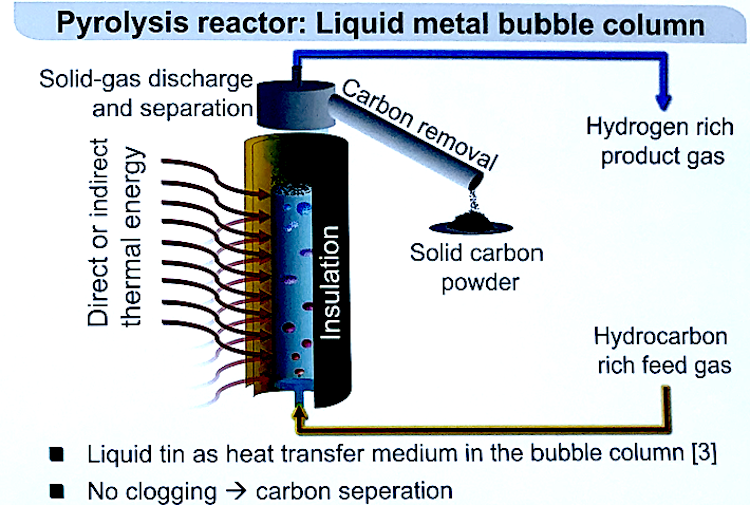
Liquid metal methane cracking reactor
1. Atmospheric Liquid-Metal Catalytic CVD (Room-Pressure Epitaxy)
Instead of generating an energy-intensive vacuum plasma to break the strong \(\text{C–H}\) bonds of methane (\(439\text{ kJ/mol}\)), liquid metal alloys act as a low-temperature catalytic solvent.
 CH₄ Gas Sparging (1 atm)
           │
           ▼
 ┌─────────────────────────────────────────────────────────┐
 │ Liquid Metal Bath: Ga-Ni, Ga-Cu, or Bi-Ni at 750–950°C  │
 │ 1. Catalytic C-H cleavage at gas-liquid bubble boundary │
 │ 2. Atomic C dissolves momentarily into liquid alloy     │
 │ 3. Liquid metal rejects C to surface / substrate seed   │
 └─────────────────────────────────────────────────────────┘
           │
           ▼
 [ Atmospheric Epitaxial Diamond Film on Seed Crystal / Cores ]
Process Mechanism: A molten eutectic mix (such as Gallium–Nickel or Tin–Nickel) held at \(800^\circ\text{C} - 950^\circ\text{C}\) in an insulated column cracks methane at atmospheric pressure. The liquid metal provides rapid catalytic cracking while remaining non-coking because carbon has low bulk solubility in gallium and floats to the surface.
Why It Cuts Costs:
Ambient Pressure: Eliminates turbo-molecular pumps, vacuum chambers, and high-vacuum seals.
No Plasma Generators: Replaces multi-kW microwave magnetrons with standard induction or resistive heating coils.
Continuous Deposition: Solid carbon can be continuously collected or directed onto seeded substrates floating at the liquid interface.
2. High-Efficiency Methane Oxy-Combustion Torches (Atmospheric Flame CVD)
Combustion-flame CVD using a fuel-rich mixture of methane and oxygen is the lowest capital cost method to synthesize diamond films and microcrystals.
Operating Mechanism:
A standard multi-nozzle oxy-fuel brazing torch is fed with a precise volume ratio of \(\text{O}_2 / \text{CH}_4 \approx 0.90 - 0.98\) (fuel-rich).
The inner primary combustion flame core reaches temperatures of \(2800\text{ K}\), dissociating methane into reactive hydrocarbon radicals (\(\text{CH}_3^*, \text{CH}_2^*\)), atomic carbon, and high concentrations of atomic hydrogen (\(\text{H}^*\)) and \(\text{OH}^*\).
Directing the inner cone tip onto a water-cooled molybdenum or silicon substrate maintained at \(800^\circ\text{C} - 900^\circ\text{C}\) deposits diamond films at \(50\text{–}150\ \mu\text{m/hr}\)—roughly \(10\times\) faster than MPCVD.
Why It Cuts Costs:
Minimal CapEx: The entire system can be built for under \(\$5,000\) using standard gas flow controllers, a water-cooled stage, and welding torches.
No Electrical Plasma Demand: Uses the chemical enthalpy of methane partial oxidation rather than grid electricity.
High Radical Flux: The high atmospheric radical density drives ultrafast linear growth rates.
3. Two-Step Pyrolysis Loop: Teal Carbon \(\rightarrow\) Confined Laser Conversion
Leveraging our prior discussion on methane pyrolysis for carbothermic reduction, this two-step architecture decouples bulk carbon cracking from diamond crystallization:
 Natural Gas (CH₄)
        │
        ▼  Methane Pyrolysis (Liquid Metal / Induction, 1.0–2.5 kWh/kg C)
 ┌──────────────────────────────┬──────────────────────────────┐
 │ Clean H₂ Gas (Monetized)     │ Ultra-Pure Teal Carbon Black │
 └──────────────────────────────┴──────────────────────────────┘
                                               │
                                               ▼  Disperse in Liquid Carrier + Tamp
 ┌─────────────────────────────────────────────────────────────┐
 │ Low-Watt Laser Shock Compression (fs / ps pulsed)           │
 │ • Optical breakdown & confined shock (P > 15 GPa)           │
 │ • Instant sp³ nucleation without graphitic ash traps        │
 └─────────────────────────────────────────────────────────────┘
                                               │
                                               ▼
                              [ Pure C-H Terminated Nanodiamonds ]
Why It Cuts Costs:
Conventional diamond synthesis from methane suffers from high dilution losses (98% of the gas is vented or recycled unreacted).
Here, 100% of the methane carbon is captured as solid, ultra-pure carbon black at low energy (\(1.0\text{–}2.5\text{ kWh/kg C}\)) while producing valuable hydrogen.
The resulting high-purity, sulfur-free teal carbon is loaded onto a target foil and flashed with a low-watt pulsed laser under quartz/liquid confinement, yielding electronic-grade nanodiamonds without requiring expensive diamondoid precursors or prolonged vacuum runs.
Economic Comparison: Conventional CVD vs. Low-Cost Methane Routes
Feature |
Conventional MPCVD |
Atmospheric Liquid-Metal CVD |
Oxy-Methane Combustion Flame |
Pyrolysis Carbon + Laser Shock |
|---|---|---|---|---|
System CapEx |
High (\(\$300\text{k} - \$1\text{M}+\)) |
Low (\(\$15\text{k} - \$35\text{k}\)) |
Lowest (\(<\$5\text{k}\)) |
Moderate (\(\$20\text{k} - \$50\text{k}\)) |
Pressure Regime |
Vacuum (\(10 - 40\text{ Torr}\)) |
Ambient (\(1\text{ atm}\)) |
Ambient (\(1\text{ atm}\)) |
Ambient (Confined shock) |
Growth / Conversion Rate |
Slow (\(1 - 10\ \mu\text{m/hr}\)) |
Moderate (\(5 - 20\ \mu\text{m/hr}\)) |
Fastest (\(50 - 150\ \mu\text{m/hr}\)) |
Instantaneous shock (\(<1\ \mu\text{s}\)) |
Energy Consumption |
Very high (\(40 - 100\text{ kWh/carat}\)) |
Low (\(5 - 15\text{ kWh/carat}\)) |
Fuel-driven (Oxy-combustion) |
Net negative / low (Offset by \(\text{H}_2\)) |
Primary Output |
Single-crystal plates / wafers |
Polycrystalline films / flakes |
Polycrystalline sheets / coatings |
Nanodiamond powders (\(2 - 5\text{ nm}\)) |
Powered by [AI Exporter](https://saveai.net)